


- CIHEAM Zaragoza and the Remedia Network have brought together more than 100 researchers and scientists from across Europe and the Mediterranean for this year’s double event: an International Seminar on 2 June followed by the XIII Remedia Workshop on 3 and 4 June.
- The experts participating in the event have highlighted the need to integrate different disciplines and expertise to tackle greenhouse gas mitigation.
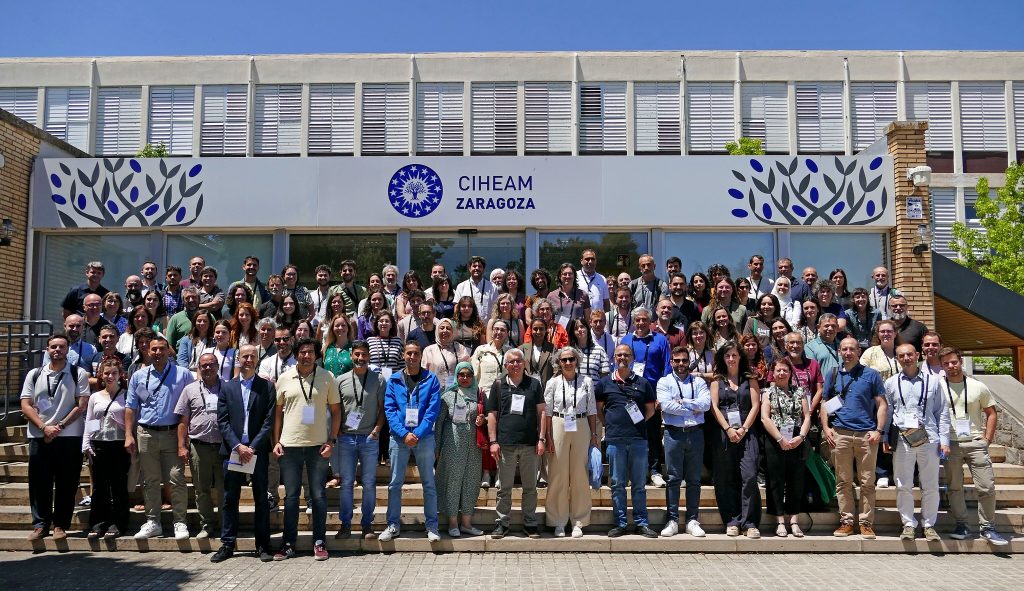
CIHEAM Zaragoza and the Remedia Network, through the Remedia+ project, have brought together more than a hundred experts in the agriculture and environment sector for the international seminar “Mitigation and Adaptation Options for Mediterranean Agriculture to Address Climate Change” held on 2 June in Zaragoza. Specialists from nine countries across the Mediterranean travelled to the capital city of Aragon to share their expertise on a range of topics including greenhouse gas (GHG) emissions, environmental impact, agriculture practices to enhance carbon sequestration, precision irrigation, animal and plant genetics, livestock feeding, and silvopastoral systems.
The keynote lecture was delivered by María José Sanz, director of the Basque Centre for Climate Change (BC3), who spoke about the multiple challenges faced by the sector: “We need scientists to connect the different fields of expertise”, in reference to the wide range of factors in the agrifood supply chain that can influence the adaptation and mitigation of environmental impact. In her concluding remarks, she recalled the importance of food security: “Concerning climate change, the issues of adapting production or mitigating GHG emissions are clear, but we have to consider the matter of food security and ensure that enough food is produced”.
Sanz went on to say: “In the past, scientists used to take more of a renaissance approach, but today, research is more focused on specialised, high-quality studies. We are accumulating knowledge but not integrating it. Therefore, seminars like this one organised by CIHEAM Zaragoza and the Remedia Network offer an excellent opportunity for researchers to connect”.
Jorge Álvaro-Fuentes, president of Remedia (the scientific network for greenhouse gas mitigation in the agroforestry sector), stated that the objective of these meetings is “scientific exchange”. This was corroborated by Antonio López-Francos, CIHEAM Zaragoza’s administrator of Cooperative Research Projects and Networks: “We want to show that the problems generated by climate change affect the whole Mediterranean region. We see it every day. Not only is it important to exchange experiences between countries, but also between scientists working in different disciplines within the agrifood sector".
Three main blocks
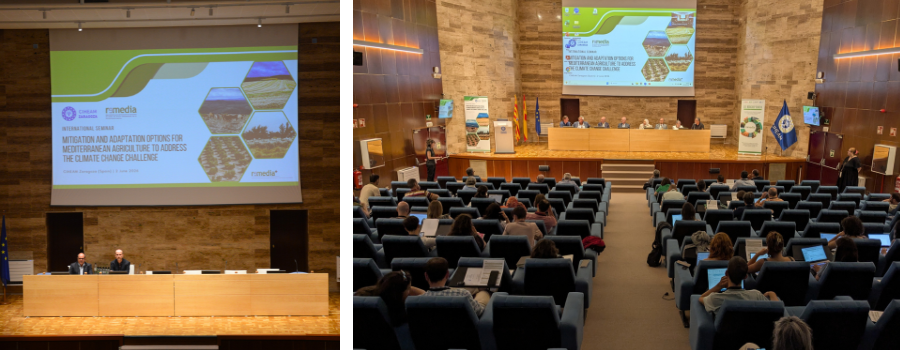
The seminar was structured in three sessions of round table discussions. In the first session –Genetic Resources and Breeding– panellists concluded that “scientists can’t solve problems by themselves”, in reference to the need for other solutions such as technological innovation and appropriate policy measures. The second and third blocks of debate revolved around Natural Resource Conservation (land, water and biodiversity) and Circularity and Input Efficiency.
Over the course of the presentations (over 20), it transpired that there were significant differences in agricultural research between the European Mediterranean countries and northern Africa and the eastern Mediterranean where they are also working on mitigation but are more focused on adapting crop and livestock production. The experts participating in the seminar coincided in the opinion that there are many strategies and practices that can reduce greenhouse gas emissions and at the same time contribute to the adaptation to climate change.
The measures for the mitigation of climate change and adaptation of agriculture and livestock farming were in fact the same in all regions: genetic improvement, study of autochthonous varieties and breeds that are less vulnerable to climatic conditions, soil carbon sequestration through cover crops, and precision farming for agriculture and livestock, use of manure and less use of synthetic fertilisers, minimizing inputs to power irrigation such as diesel or electricity.
Participants visited a field trial in which the Agri-Food Research and Technology Centre of Aragon (CITA) and the Polytechnical University of Madrid are participating to evaluate different application techniques in the field to reduce ammonia losses. This study is run by AgrosceNaLab, a research initiative financed by the National Spanish R&D plan, which aims to assess the potential of crop soils in Spain for nitrogen recycling to limit dependence on external sources of fertilisers.
Annual Workshop of the Remedia Network
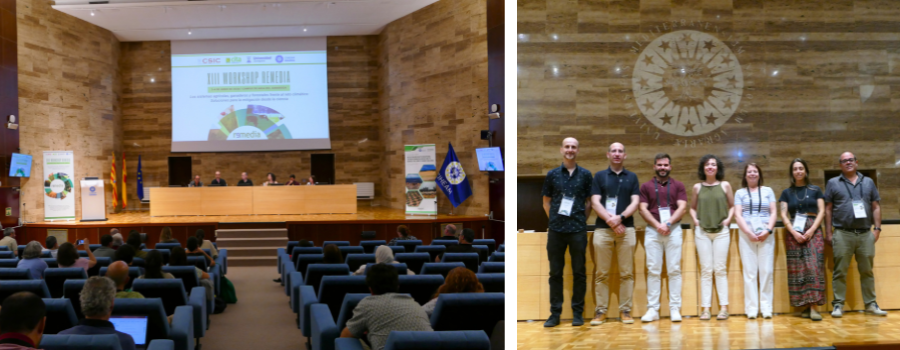
On 3 and 4 June, the Remedia Network held its XIII Annual Workshop, co-organised with CIHEAM Zaragoza, CSIC, CITA and the University of Zaragoza, where 90 papers were presented on research that is currently being conducted on climate change mitigation and adaptation in the agricultural sector. More than half of the studies were linked to agriculture, but there were also projects on livestock farming, forests and socioeconomics.
One project focused on the use of garlic, cinnamon and oregano as livestock feed additives to reduce methane emissions in ruminants. Researcher Alejandro Belanche from the University of Zaragoza explained more about the study: “Garlic offers the most potential but is less palatable when used in high doses and can taint the milk, which is why we are studying blends with cinnamon and oregano”.
The National Institute of Agricultural and Food Research and Technology (INIA-CSIC) presented a study to show the efficacy of the Common Agriculture Policy’s carbon eco-schemes (crop rotation and no tillage). Researcher José Luis Gabriel presented the study "Cover crops and no-tillage practices increase the amount of carbon in the soil", with conclusions based on comparisons of data collected from 16,000 crop farms across Spain.
CIHEAM Zaragoza contributes to climate change mitigation and adaptation in Mediterranean agriculture by providing high-level training for technical staff and researchers from its member countries. Since 2020 it has organised 15 advanced courses on these topics and is currently preparing 3 more for 2026. With the launch in 2023 of a Mediterranean network for knowledge exchange on GHG emissions and climate change mitigation in agriculture, CIHEAM Zaragoza also participates in research and innovation projects on the subject, including Re-Livestock (livestock) and CAMA (crops), and is a member of the Global Research Alliance for Agricultural Greenhouse Gases (GRA). Some of these activities have been conducted in collaboration with other international institutions such as ICARDA, the FAO and GRA, as well as with Spanish organisations such as the Remedia Network.
Remedia is the Spanish national scientific network for climate change mitigation in the agroforestry sector. Remedia connects research groups in different geographical and thematic areas, aiming to link research with action, promoting collaborative projects for scientific outreach and technology transfer to achieve sustainable agriculture and forestry management.