


- The painting symbolises CIHEAM Zaragoza’s mission and its impact on young people and professionals, empowering them to soar to new heights.
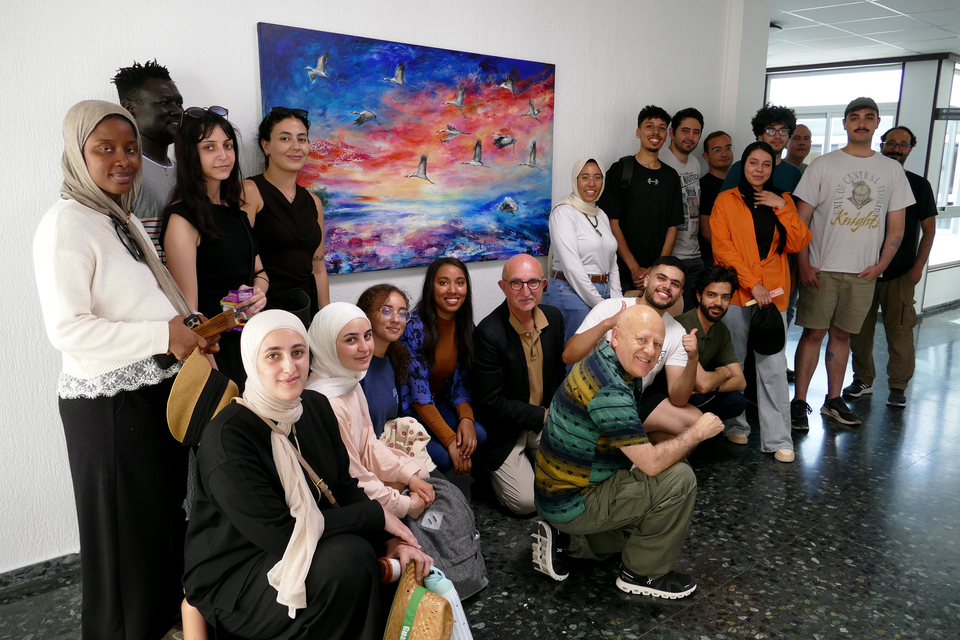
Zaragoza, 1 June 2026.- Aragonese painter Carlos Pardos has unveiled his latest work at CIHEAM Zaragoza: El despegar de las grullas (Cranes Taking Flight). Depicting a flock of cranes ascending into the dawn sky, the painting serves as a powerful metaphor for the cohesion of an international organisation working towards shared goals and for the transformative influence on the young people and professionals who participate in the Centre’s training and research activities, empowering them to soar to new heights.
Raúl Compés, Director of CIHEAM Zaragoza, describes what the painting means for him: “This painting represents the mission of CIHEAM Zaragoza. Cranes provide a compelling metaphor: They travel together, reach great heights, cover vast distances, and cross international borders towards new horizons”.
In large format, the painting combines figurative representation with passages of abstraction in its treatment of sky and water. Pardos captures the dramatic interplay of light and colour at daybreak, portraying the iconic formation flight of cranes departing from Gallocanta lagoon in the province of Zaragoza, the artist’s birthplace and enduring source of inspiration. The luminous palette and radiant atmosphere that accompany the birds are among the most striking features of the work, now displayed on the premises of CIHEAM Zaragoza.
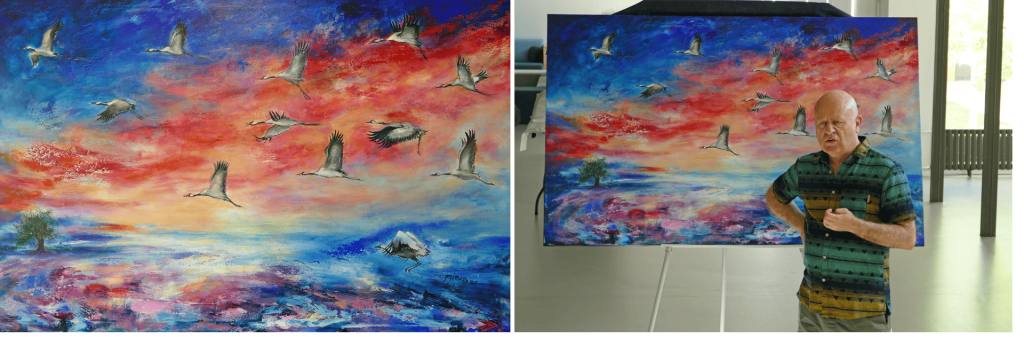
The artist offers some cultural background to the painting. “Throughout the Mediterranean, cranes have long been regarded as bearers of good fortune and have traditionally been associated with agricultural cycles and rhythms of nature. Their arrival in autumn announces colder weather and rainfall, while their migration towards the North signals the beginning of spring”.
The symbolism of the cranes is closely aligned with CIHEAM Zaragoza’s work in training, research, and cooperation in the scope of agriculture, food systems and rural development. For Pardos, the painting also expresses the importance of integrating creativity in scientific work. “Art, design and creativity are intrinsically linked to research and education”, Pardos explains. “For this reason, I encourage students, researchers and educators, particularly in the age of artificial intelligence, to embrace creativity as an integral part of their work. In a rapidly changing world, creativity has the power to enrich our learning processes”.
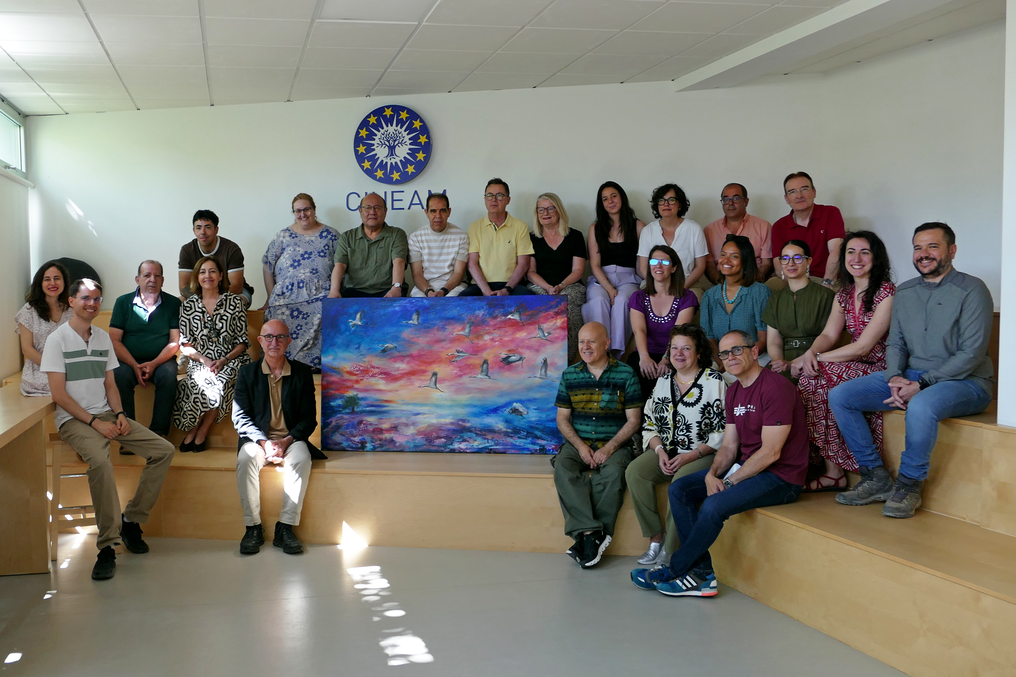
With this work, CIHEAM Zaragoza continues to modernise the Centre’s facilities, integrating art and culture into an environment dedicated to training, research, innovation, technical assistance and development cooperation projects.
In his paintings, Carlos Pardos conveys the grace and powerful collective movement of the cranes across the evocative landscapes of Gallocanta lagoon (Zaragoza). Although he trained at the Escola Massana in Barcelona, it was in his native territory that he discovered the visual and emotional universe that would shape his distinctive artistic language. According to art curator Diego Arribas, PhD in Fine Arts and member of the International Association of Art Critics, “Carlos Pardos evokes the migratory spirit of the crane, journeying from figuration to abstraction, from tenebrism to colour, and from painting as representation to painting as a lived experience”. This artistic evolution was acknowledged at the major exhibition El vuelo de la grulla (The Flight of the Crane), presented at the Palace of La Alfranca (Zaragoza). Bringing together one hundred works created over more than a decade, the exhibition attracted a wide audience, earning both critical acclaim and commercial success. For further information, visit carlospardos.com.