

- According to the organisers, the forum gathered approximately 3000 participants, including government representatives, international organisations, water management agencies, financing bodies and research centres in the Euro-mediterranean area
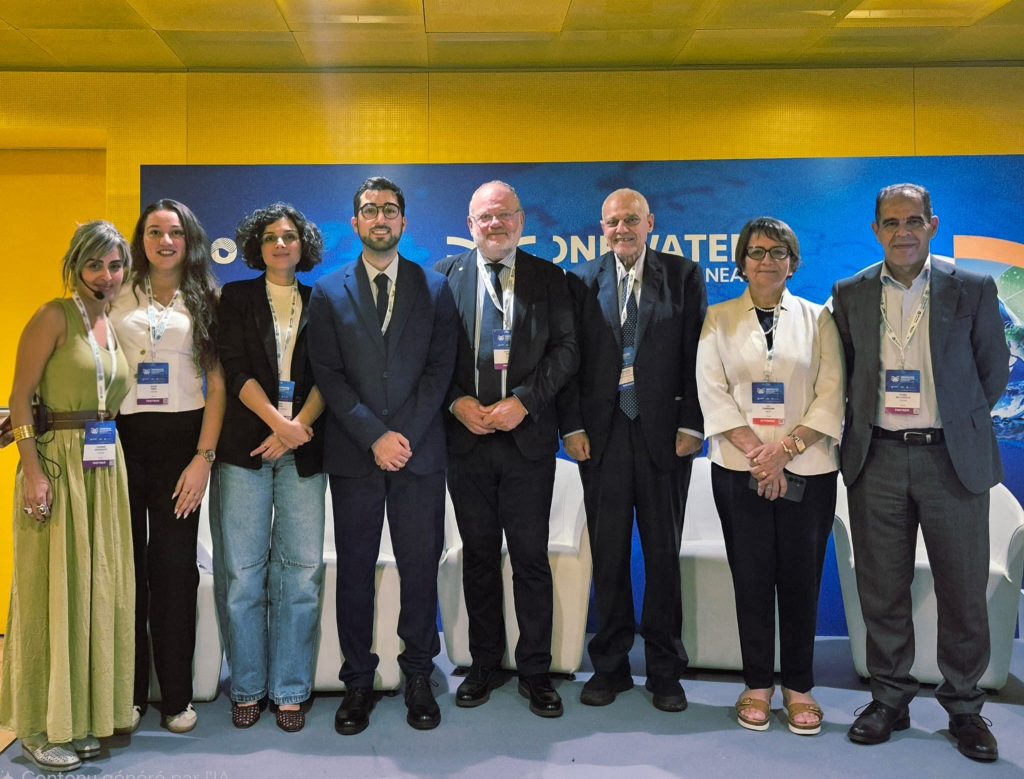
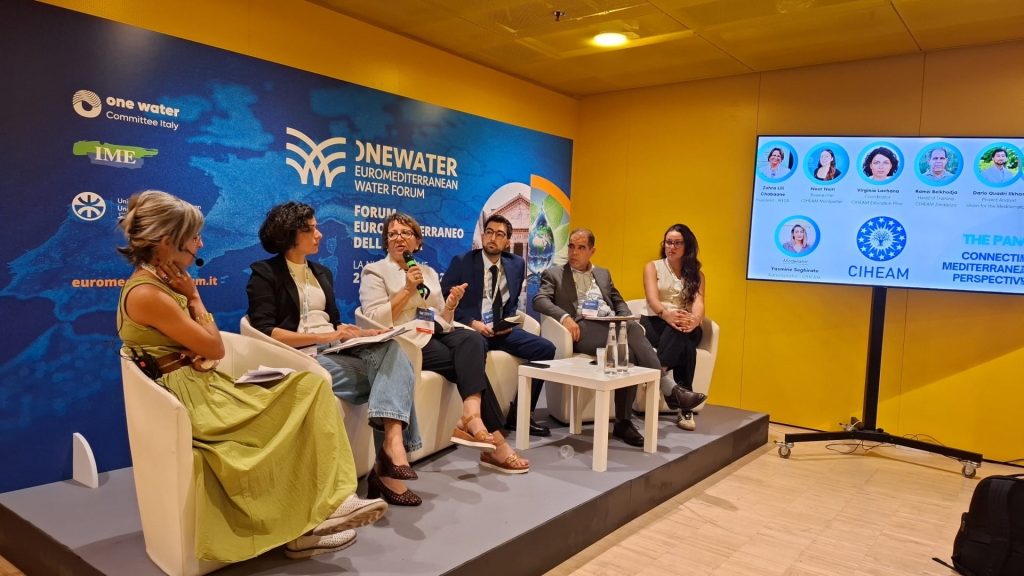
- CIHEAM Zaragoza took part in the workshop ‘Water security in the Mediterranean: connecting knowledge, skills and regional cooperation’, held in Rome on 1 October
From 29 September to 2 October, Rome hosted the EuroMediterranean Water Forum under the title ‘One Water’, organised by the Italian ‘One Water’ committee, the Mediterranean Water Institute (IME) and Union for the Mediterranean (UfM). Over the four days, La Nuvola brought together representatives of governments, international bodies, water management agencies, financing entities and research centres in the Euro-mediterranean area to discuss topics ranging from water scarcity, non-conventional water resources, the water-energy-food-ecosystems (WEFE) nexus and governance to investment funding.
The CIHEAM network played a prominent role. CIHEAM Bari organised the sessions ‘One Water II’, the launch of the ‘Rome Water Initiative’, as well as encounters between project promoters and investors for the Balkans and northern Africa and a ministerial debate on the Western Balkans. The General Secretariat coordinated the workshop of 1 October, ‘Water security in the Mediterranean: connecting knowledge, skills and regional cooperation’, completing CIHEAM’s contribution to the forum.
CIHEAM Secretary General Teodoro Miano opened the session, chaired by Yasmine Seghirate, featuring contributions from Biagio Di Terlizzi (CIHEAM Bari), Nour Nsiri (CIHEAM Montpellier), Zohra Lili Chabaane (IRESA, Tunisian delegate to CIHEAM), Ramzi Belkhodja (CIHEAM Zaragoza), Virginia Lachana (CIHEAM) and Dario Quadri Ilkhani (UfM). The session concluded with a contribution from Hussein El-Atfy, Secretary General of the Arab Water Council.
CIHEAM Zaragoza’s role
Ramzi Belkhodja, head of Training at CIHEAM Zaragoza, provided an overlook of the Institute’s experience in water management projects in agriculture: MEDROPLAN (drought preparedness); TELERIEG (remote sensing for irrigation); and WATNITMED and QUALIWATER (integrated water and nutrient management in agriculture).
Belkhodja pointed out that key factors for success include early engagement of users, clear institutional responsibility and practical training, enabling farmers and technical experts to understand these instruments and take part in their design. He also highlighted challenges, such as financing and project afterlife. Moreover, greater irrigation efficiency does not necessarily lead to water saving at catchment level therefore the water balance needs to be assessed.
As a final message, he proposed to integrate verifiable water management instruments in all water investments: assess the water balance, agree on sustainable allocations and finance monitoring and management capacities. In this sense, training and regional cooperation are essential to interpret evidence, adapt approaches and share lessons learnt between Mediterranean countries.
Conclusions of the forum
The forum put the spotlight on the new regional policy framework for 2026-2030, with five priorities, three strategic frameworks and the ‘Rome Water Initiative’, whose objective is to strengthen technical capacities and prepare fundable projects.
Several messages were repeated throughout the forum. The Mediterranean is one of the regions most exposed to climate change and moreover suffers both droughts and floods, one reason why reuse and desalination were proposed as structural and not circumstantial measures. References to water financing through blue funding and public development banks, as well as the preparation of bankable projects were heard in many of the debates. Several sessions insisted on the need to stop thinking about ‘Nexus’ and to implement it, moving from analysing the water-energy-food-ecosystem nexus to putting it into practice. Regarding groundwaters, examples were taken from Morocco and Tunisia to illustrate the need to replace crisis management with anticipatory governance.
Another aspect that arose during the forum was that the transformation of water management generates a need for new skills and therefore training systems must adapt more rapidly. Several participants spoke frankly about current limitations: the gap between pilot projects and upscaling, lack of financing to prepare projects, limited transfer of research results to the field, and exodus of talent. Experts coincided in the need to turn diagnostics into concrete actions. This framework opens up opportunities for CIHEAM Zaragoza’s offer in training and projects activities, providing solutions through training and regional cooperation.