


- Twenty-four fisheries professionals from 11 countries took part in the course, held on board the Intermares training vessel in Tenerife from 14 to 18 September 2026.
- The training aimed to improve the quality of fisheries data and strengthen the technical capacity of scientific observers, a key element in the sustainable management of marine resources.
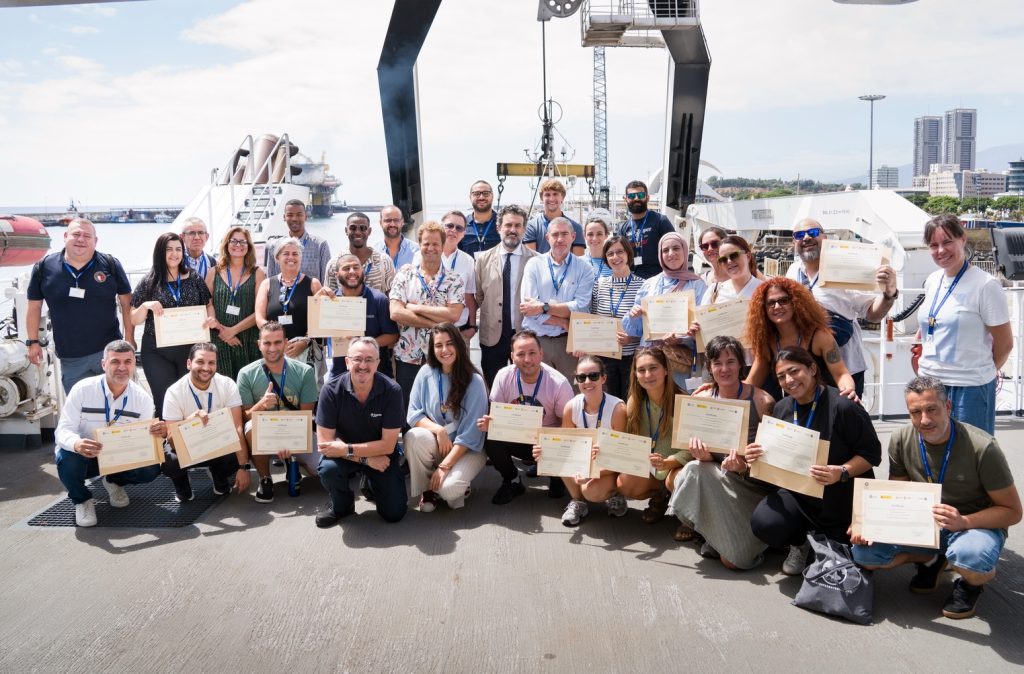
Twenty-four fisheries professionals from 11 countries in Europe, Africa, the Maghreb region and the Middle East attended the advanced course on Fisheries Scientific Observers, held on board the Intermares training vessel, Tenerife (Spain), from 14 to 18 September 2026. The course was organised jointly by the Spanish Ministry of Agriculture, Fisheries and Food (MAPA), through the General Secretariat for Fisheries (SGP), CIHEAM Zaragoza, the Masar al'an programme of the Spanish Agency for International Development Cooperation (AECID), and the Spanish Institute of Oceanography (IEO-CSIC), in collaboration with the General Fisheries Commission for the Mediterranean (GFCM) of the Food and Agriculture Organization of the United Nations (FAO).
Sustainable fisheries management must be based on a sound understanding of the state of fish stocks and on compliance with management strategies, regulations and fisheries policies. To this end, fisheries-dependent data plays a key role and is collected by trained, specialised scientific personnel on board fishing vessels. Working as a scientific observer on fishing vessels provides an understanding of the mechanics of fishing operations, the functioning of fishing gear, and a comprehensive overview of the composition of commercial and unwanted catches (discards and incidental catches of protected species).
Scientific fisheries monitoring involves a wide range of activities, such as identifying species; size sampling; collecting biological samples for studies on growth, reproduction, diet and genetics; and tagging marine species for studies on migration and survival. In addition, observers monitor bycatches of species that are protected or vulnerable to fishing (marine mammals, turtles and sharks). Currently, the development of new technologies applied to fisheries observation, such as electronic monitoring, has presented new challenges for fisheries monitoring, in which human observers continue to play a very prominent role.
The data collected is used by fisheries assessment groups to produce technical reports on the portion of the stock exploited by fishing. Furthermore, the data and reports are used in forums, committees and working groups for decision-making regarding the management of renewable marine resources and therefore have a significant socio-economic impact on the fishing industry.
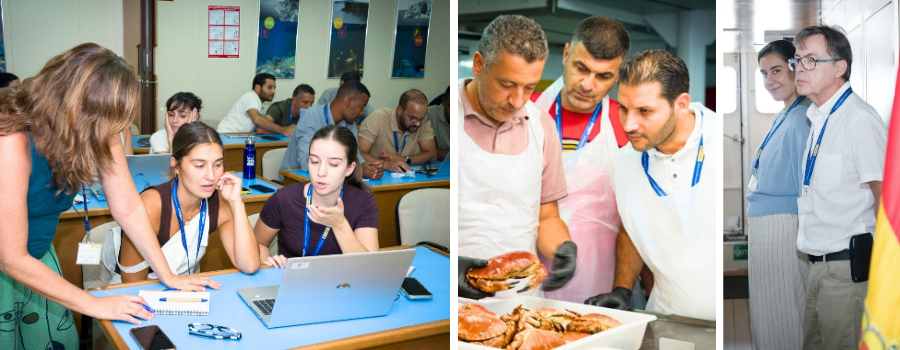
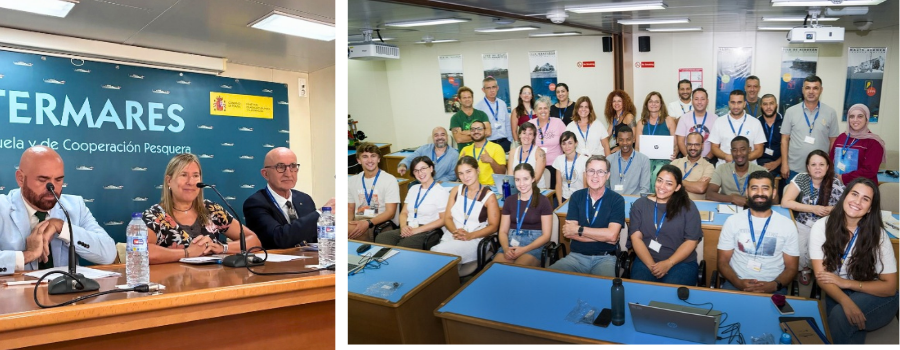
Over the course of the five-day programme, including a guided visit of the vessel, theoretical sessions were combined with three practical sessions and a round table discussion. It provided participants with training on scientific fishing observation programmes, methodologies and protocols applied to different types of fleets and fisheries, and on new technologies applied to fisheries monitoring.
Participants were able to discuss and expand their knowledge of the most relevant topics covered during the course. Examples include interactions with fishers, current regulations on scientific fisheries observation, and the quality of professional work in different countries. There was also discussion on the need to improve observers' working conditions, to ensure a greater presence of observers on fishing fleets, and to provide specialised, high-quality ongoing training that enables them to adopt new technologies and methodologies for data collection, information analysis and report writing.
The programme was delivered by experts from the organising and collaborating institutions (IEO-CSIC and the Marine Research Institute, IIM-CSIC). It included sessions on scientific fisheries observation (skills, training, challenges); fundamentals of scientific fisheries sampling and obtaining fisheries data; fisheries observation methodology; fishing data logging; scientific identification of fishing species; fishing observation in different types of fleets (data types, reports and Regional Fisheries Management Organisations RFMOs); analysis of information from observer programmes; and scientific monitoring of the impact of fishing: vulnerable marine ecosystems and electronic observation systems on board fishing vessels.
Throughout the course, participants were divided into groups to take part in three practical sessions focused on: (i) species identification, weight and length measurements; (ii) biological sampling with dissection of individuals; and (iii) data analysis based on a case study with data collected through an observational survey, in which participants worked in pairs using computers to analyse and interpret scientific fisheries data and produce a short report.
Through this training, MAPA (SGP), CIHEAM Zaragoza, the AECID Masar al'an programme and IEO-CSIC reinforce their commitment to improving the quality of fisheries data and strengthening the technical capacity of scientific observers, a key element in the sustainable management of marine resources.