


- More than 120 representatives of governments, international organisations, financial institutions and women entrepreneurs met in Tunis on 28–29 October to discuss the draft Regional Policy Agenda 2026–2030 on innovation for women entrepreneurs in agri-food systems.
- The conference forms part of the work of the Joint Regional Task Force led by the UfM in partnership with CIHEAM, FAO and AECID.
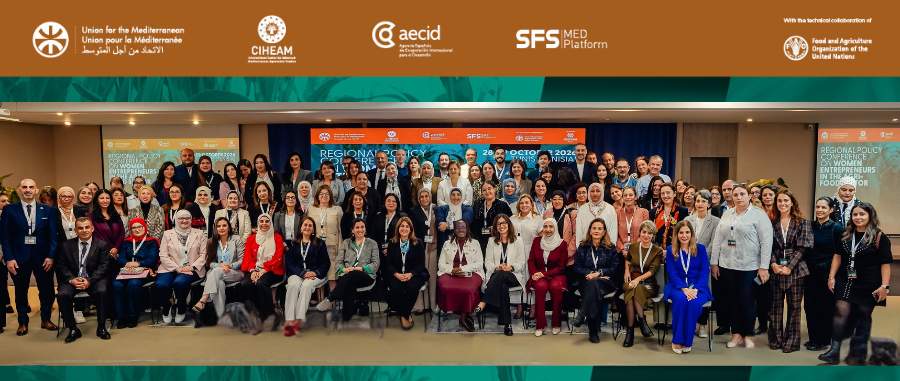
The initiative has its origins in the conversations held at the Zaragoza Symposium Women’s Empowerment through Innovation in Mediterranean Agro-food Systems in June 2025. That exchange has since grown into a regional process which, on 28–29 October, brought together more than 120 participants in Tunis.
Organised under AECID’s Masar Al’an programme, the conference welcomed the participation of partners from Algeria, Egypt, Jordan, Lebanon, Morocco, Palestine and Tunisia. CIHEAM Zaragoza took part as a member of the Task Force.
A central item was the presentation and discussion of the draft Regional Policy Agenda 2026–2030 on Innovation for Women Entrepreneurs in Agri-Food Systems, developed through a participatory process with stakeholders from seven southern Mediterranean countries. The discussions helped to refine its priorities and to identify concrete actions for its implementation.
Policy dialogues, thematic panels and participatory working sessions addressed innovation, financing, entrepreneurship support ecosystems and women’s leadership, with emphasis on closer cooperation among public institutions, financial bodies, universities and research centres, the private sector and development partners.
Women entrepreneurs played a central role, sharing first-hand experience of the opportunities and obstacles involved in setting up and growing innovative agri-food businesses. Their testimonies showed that policies must respond to the realities and needs of women working along agricultural value chains. They also pointed out that talent, innovation and resilience already exist; what is often missing is a structured ecosystem, with access to innovation and finance, that allows them to grow and lead.
Participants from across the southern Mediterranean agreed on placing governance, policy coordination and multi-stakeholder partnerships at the centre of future efforts. Each actor has a role to play: governments can create enabling policies; financial institutions, develop more inclusive products; universities and research centres, foster innovation; business support organisations, offer mentoring and networks; and regional platforms, bring everyone together around shared goals.
The priorities identified include strengthening national coordination and ownership; widening women’s access to finance and innovation (innovation without finance rarely reaches the market, and finance without innovation rarely delivers transformative impact); improving technology transfer and knowledge exchange; promoting women’s leadership in value chains and producer organisations; strengthening evidence-based policy and data collection; and scaling up successful regional initiatives through stronger partnerships.
Main messages
Despite the diversity of contexts, the message was consistent: solutions do not need to be reinvented but connected. The conference closed with firm support for a coordinated regional approach to women’s entrepreneurship and innovation in agri-food systems. The recommendations gathered will inform the finalisation of the Regional Policy Agenda 2026–2030 and its Action Plan, guiding future efforts towards more inclusive, resilient and sustainable agri-food systems across the Mediterranean.
In his opening remarks, Isidro Antonio González Afonso, Ambassador of Spain to Tunisia, highlighted that “women are present at every stage of the agri-food value chain: they sow, harvest, process, raise livestock, and preserve seeds. At every stage, except the last. They leave the chain precisely when monetary value begins to be created: when products are sold, prices are set, and credit contracts are signed. It’s not a question of skills, but of access: access to land, financing, markets, and decision-making spaces”.
Sanaa Zebakh, Director of PRIMA, added that “when you empower a woman in agri-food innovation, you do more than support an entrepreneur: you plant the seeds of change for her community and for generations to come. When a woman grows, her impact extends far beyond her own success”.
CIHEAM Secretary General Teodoro Miano pointed out that “our countries have no shortage of initiatives to support women entrepreneurs. But these mechanisms still too often operate in isolation. Our challenge is to coordinate them better, simplify procedures, and facilitate women’s journey, from training to developing their businesses”.
About the initiative
The conference was organised by the Union for the Mediterranean (UfM) with the support of the Spanish Agency for International Development Cooperation (AECID) through the Masar Al’an programme , and in collaboration with FAO, PRIMA, CIHEAM, Berytech, Chemonics, CAWTAR, MedWaves, BETA Technological Centre and Impact Partner, all committed to women’s economic empowerment, innovation and sustainable development in the Mediterranean.