


- Forty-five professionals from five continents took part in the advanced course, held in Granada, Spain, and online from 27 to 29 October 2026
- Nutritional strategies, measurement techniques and emissions accounting are key to advancing methane mitigation in livestock production
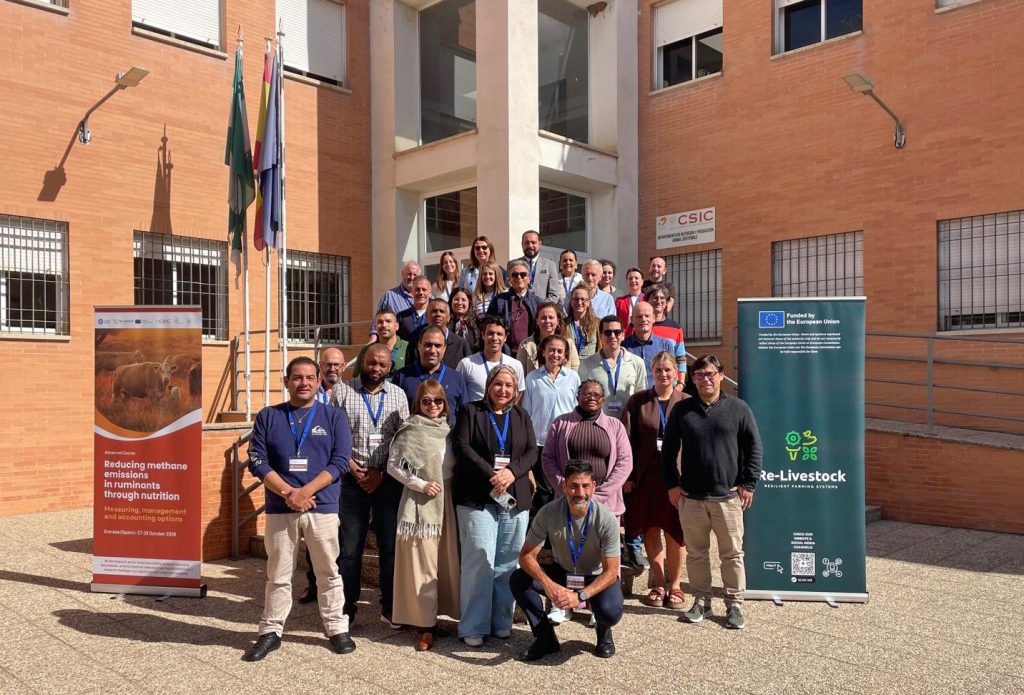
Forty-five professionals from five continents took part in the advanced course ‘Reducing methane emissions in ruminants through nutrition: measuring, management and accounting options’ held in Granada, Spain, and online from 27 to 29 October 2026. The training provided an opportunity to explore scientific advances and practical approaches to reducing methane emissions from ruminant livestock, with a focus on nutritional strategies, measurement techniques and emissions accounting.
The course was co-organised by CIHEAM Zaragoza and the Spanish National Research Council (CSIC), as partners in the European research project Re-Livestock, together with two international initiatives working on greenhouse gas mitigation: the Global Research Alliance on Agricultural Greenhouse Gases (GRA) and the Global Methane Hub (GMH). International experts contributed throughout the course, including specialists from CSIC, Scotland’s Rural College (SRUC), Wageningen University & Research (WUR), GRA, the University of California, Davis (UC Davis), the agriculture ministries of Spain and New Zealand, and other organisations in the livestock sector.
Understanding methane emissions and their mitigation
Reducing enteric methane emissions is one of the key challenges facing livestock production as the sector moves towards more sustainable and climate-resilient systems. Addressing this challenge requires a sound understanding of the biological processes involved, alongside effective mitigation strategies that can be adapted to different production contexts.
The course programme provided an overview of global methane emissions and developments in mitigation strategies for ruminants. Participants examined the biological processes underlying methane production in the rumen, including rumen anatomy, microbial ecology, fermentation and the biochemical pathways involved.
Different methane measurement techniques were also explored, combining theoretical sessions with practical demonstrations. These activities allowed participants to become familiar with available tools and discuss their applications and limitations across different geographical contexts.
Nutritional strategies and their practical application
A substantial part of the course focused on nutritional approaches to reducing enteric methane emissions. Participants examined how feed composition, nutrient availability and feeding practices can influence methane production, with practical examples from grazing, semiarid and temperate livestock systems.
Particular attention was given to feed additives, including their technical development and potential to reduce emissions. The programme also addressed the regulatory frameworks governing their authorisation in Europe and New Zealand, as well as the challenges associated with their acceptance and adoption in practice. Discussions considered perspectives from across the value chain, from farmers to consumers, highlighting the importance of connecting scientific advances with the needs and realities of livestock production.
Modelling and accounting for emission reductions
The final part of the programme addressed the modelling and accounting of methane emission reductions. Participants explored approaches to assessing mitigation outcomes at different levels, from individual animals and farms to value chains and national greenhouse gas inventories.
Practical examples from New Zealand, Spain and the United Kingdom illustrated how farm-level indicators can be integrated into emissions assessment and accounting systems. The programme also examined modelling tools and potential trade-offs with other sources of greenhouse gas emissions associated with livestock farming.
These discussions underlined the importance of reliable measurement and accounting methods to evaluate the effectiveness of mitigation strategies and support evidence-based decision-making.
Building knowledge for more sustainable livestock production
By bringing together scientific knowledge, hands-on learning and strategic perspectives, the course highlighted that reducing emissions requires more than identifying promising technologies. Their practical adoption by farmers, appropriate regulatory conditions and robust methods for assessing their impact are equally important.
The course was organised within the framework of Re-Livestock, a Horizon Europe-funded research project running from 2022 to 2027 that aims to reduce greenhouse gas emissions from livestock production systems and enhance their capacity to adapt to climate change through innovative practices.
As a project partner, CIHEAM Zaragoza is responsible for technical and scientific training activities, among other tasks. The next advanced course planned under this project is scheduled for 2027 and will focus on developments in life cycle assessment (LCA) applied to livestock farming.