



Advanced course
Genotyping and phenotyping in legumes: Tools, data and decisions for legume breeding
- 12-16 April 2027
- Face-to-face (Córdoba, Spain)
- 976 716 000
- iamz@zaragoza.ciheam.org
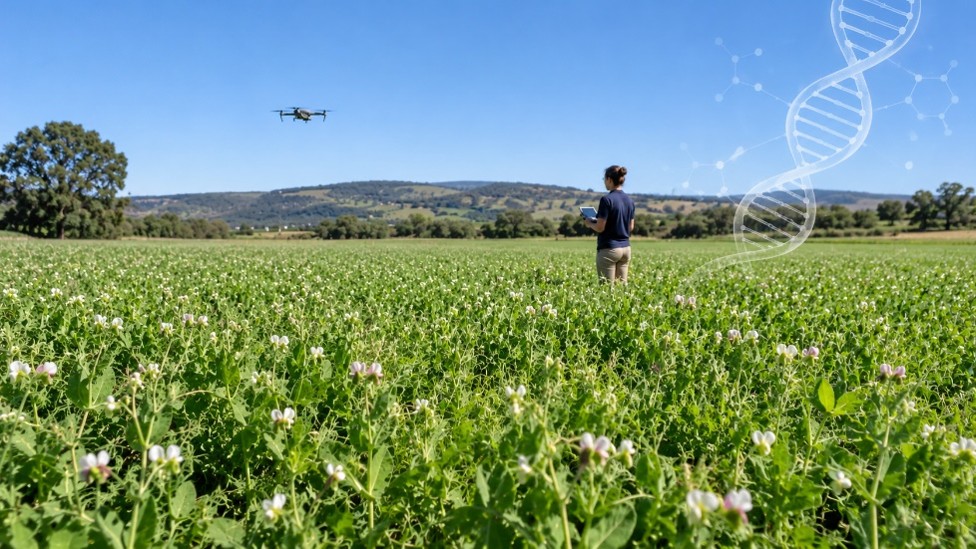



INFORMATION ABOUT THE ADVANCED COURSE
Legume breeding is being reshaped by two sets of technologies that have matured at very different speeds. On the genotyping side, the fall in sequencing costs, the consolidation of genotyping-by-sequencing, targeted genotyping and SNP arrays, and the recent availability of reference genomes and pangenomes for the main legume species have turned marker information into something a breeding programme can generate routinely rather than exceptionally. On the phenotyping side, remote sensing, UAV imagery, spectroscopy and image analysis have begun to clear the measurement bottleneck that has historically limited the number of genotypes a programme can evaluate, and machine learning is changing how both kinds of data are analysed. Between the two sets of technologies sit prediction models— marker-assisted, genomic and phenomic selection —which have moved from proof of concept to formal integration with phenotypic selection in both grain and forage legumes. Policy frameworks such as the European Green Deal, the Farm to Fork strategy and the European push for protein autonomy have simultaneously raised the demand for improved legume varieties, and with it the demand for professionals able to combine these tools in a coherent breeding strategy.
These opportunities reach legumes under conditions that differ markedly from those of the major cereals. Legume breeding applies to a heterogeneous group of species — chickpea, faba bean, pea and lentil among the grain legumes, lucerne and clovers among the forages — that span inbred and outbred reproductive systems, annual and perennial cycles, and very different levels of genomic resources and community size. Breeding programmes are usually small and work with limited budgets, with support from a range of funding sources, including public funds. In this context, the choice between a cheap marker panel and a dense genotyping platform, or between manual measurement and an image-derived trait, has real consequences for costs and accuracy rather than being merely a technical detail. Environmental changing conditions add their own constraints: from cold in autumn-sown crops to drought and heat, impact on crop cycles, soil-borne pathogens, foliar diseases and pests, and quality traits such as protein content and antinutritional compounds that determine the end use of the harvest. Expertise on these questions is fragmented across institutions, disciplines and countries, and methods developed for other crops or other climates cannot simply be transferred. There is therefore a clear need for an advanced, integrated course that brings genotyping, phenotyping and the analytical tools that connect them into a single framework, applied to legume species and to Mediterranean and European breeding contexts.
The course is designed to equip plant breeders, researchers, technicians and practitioners with the knowledge and tools required to combine genotyping and phenotyping in legume breeding programmes. It follows the path a breeder actually takes: from the plant sample to the marker dataset, from the marker dataset to a selection decision, from the field to the image and from the image back to a trait value that can be used in a selection index. The programme connects genotyping and sequencing technologies with marker-assisted, genomic and phenomic selection, and the design of phenotyping protocols with case studies on biotic stress, abiotic stress and quality, high-throughput image-based phenotyping and the integration of both data types. Participants will engage in a comprehensive learning experience that combines theoretical lectures, guided debates, case studies, hands-on sessions on real legume datasets, a technical visit to the IAS-CSIC & IFAPA legume breeding trials in Córdoba and final group work, all aimed at providing a sound understanding of the principles, benefits and practical applications of these technologies. To achieve these goals, the course aims to:
- Provide a thorough understanding of the genotyping and sequencing technologies available for forage and grain legumes, of the reference genomes and pangenomes now accessible, and of the cost, throughput and sample logistics criteria that govern the choice of platform for a given breeding objective.
- Empower breeders, researchers, technicians and practitioners with the knowledge and tools needed to turn predictive breeding information into selection decisions, through marker-assisted, genomic and phenomic selection adapted to their own breeding schemes and budgets.
- Deliver a clear understanding of the design of phenotyping in legume breeding: trait definition and scoring scales, experimental design, precision and repeatability, heritability, genotype × environment interaction and the real value of a phenotype.
- Explore, through case studies on grain and forage legume species, the evaluation of biotic stresses (soil-borne pathogens, foliar diseases and pests), abiotic stresses (drought, heat and cold) and quality traits under Mediterranean and European conditions.
- Showcase the contribution of remote sensing, UAV imagery, spectroscopy and image analysis to high-throughput phenotyping, and the complete pipeline that leads from raw images to trait values usable in a selection index.
- Acquire knowledge through theoretical lectures, guided debates, case studies, hands-on sessions, a technical field visit and group work focused on applied legume breeding methodologies.
Course objectives
The course will enable participants to:
- Acquire a comprehensive understanding of the genotyping and sequencing technologies currently available for forage and grain legumes, and of their significance for breeding programmes of different size, species and budget.
- Select an appropriate genotyping platform for a given breeding objective and follow the steps that lead from raw sequence data to a quality-controlled marker dataset: variant calling, filtering, imputation and data management within a breeding programme.
- Move from QTL and GWAS results to validated, breeder-ready diagnostic markers, and apply marker-assisted selection in practice on grain and forage legume material.
- Understand how genomic and phenomic prediction models are built, trained and validated, what prediction accuracy means, and how it translates into genetic gain per unit of time and cost within perennial and annual legume breeding schemes.
- Design a phenotyping protocol for a target trait, choosing scoring scales, experimental designs and levels of precision appropriate to the trait, the species and the resources available.
- Set up and interpret evaluation assays for biotic stresses, abiotic stresses and seed quality traits in grain and forage legumes, drawing on the case studies presented during the course and on the trials seen during the technical visit.
- Plan and interpret image-based phenotyping, from flight planning, ground control points and image acquisition to plot segmentation, extraction of vegetation indices and the export of a phenotypic table ready for analysis.
- Integrate genotypic and phenotypic information, and adapt it to design sound, context-specific genotyping and phenotyping strategies for their own breeding objectives, target environments and budgets.
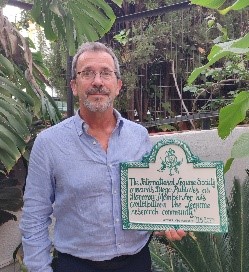
Course coordination


Registration
Applications must include a curriculum vitae and a copy of the support documents most related to the subject of the course. The deadline for the submission of applications is 13 December 2026.
Applications from candidates requiring authorisation to attend the course may be accepted provisionally.
There are no registration fees for this course, but participants must cover their own travel and accommodation costs.
FAQs
Who should attend
The face-to-face course is designed for 25 participants with a university degree and aimed at plant breeders from public institutions and from seed and breeding companies, researchers, PhD candidates, technicians of breeding and evaluation programmes, agricultural extension agents, advisors and practitioners from Mediterranean and European countries involved in legume breeding, plant genetics, plant pathology, agronomy, crop phenotyping and variety evaluation. A basic background in quantitative genetics is assumed, and participants are asked to bring a laptop for the practical sessions.
Guest lecturers
Annicchiarico, Paolo – CREA, Italy
Barilli, Eleonora – IAS-CSIC, Spain
Castro, Patricia – UCO, Spain
González, Mario – IAS-CSIC, Spain
Gutiérrez, Natalia – IFAPA, Spain
Julier, Bernadette – INRAE, France
Kasprzak, Arno – ILVO, Belgium
Lootens, Peter – ILVO, Belgium
Mahmood, Anser – Legume Generation, Czech Republic
Muylle, Hilde – ILVO, Belgium
Pégard, Marie – INRAE, France
Rojas, José Manuel – IFAPA, Spain
Rubiales, Diego – IAS-CSIC, Spain
Visioni, Andrea – ICARDA, Morocco
Course Format and Approach
The course will be held face-to-face for one week, in morning and afternoon sessions, at IAS-CSIC Córdoba (Spain), from 12 to 16 April 2027.
The course is designed to equip plant breeders, researchers, technicians and practitioners with the knowledge and tools required to combine genotyping and phenotyping in legume breeding programmes. It follows the path a breeder actually takes: from the plant sample to the marker dataset, from the marker dataset to a selection decision, from the field to the image and from the image back to a trait value that can be used in a selection index. The programme connects genotyping and sequencing technologies with marker-assisted, genomic and phenomic selection, and the design of phenotyping protocols with case studies on biotic stress, abiotic stress and quality, high-throughput image-based phenotyping and the integration of both data types. Participants will engage in a comprehensive learning experience that combines theoretical lectures, guided debates, case studies, hands-on sessions on real legume datasets, a technical visit to the IAS-CSIC & IFAPA legume breeding trials in Córdoba and final group work, all aimed at providing a sound understanding of the principles, benefits and practical applications of these technologies.
Financial support
Candidates from CIHEAM member countries, the European Union, and neighbouring countries may receive financial support for travel and accommodation costs. The deadline to apply for financial support is 13 December 2026.
Preference will be given to low- and middle-income countries. If you wish to request financial support, please complete the relevant section when you apply online to participate in the course.
Candidates from other countries who require financial support should apply directly to national or international institutions.
All applications are subject to a selection process based on the profiles submitted.
Insurance
It is compulsory for participants attending the course in person to have medical insurance valid for Spain. Proof of insurance cover must be given at the beginning of the course. Those who so wish may participate in a collective insurance policy taken out by the Organisation, upon payment of the stipulated sum.
With the collaboration and support of: