


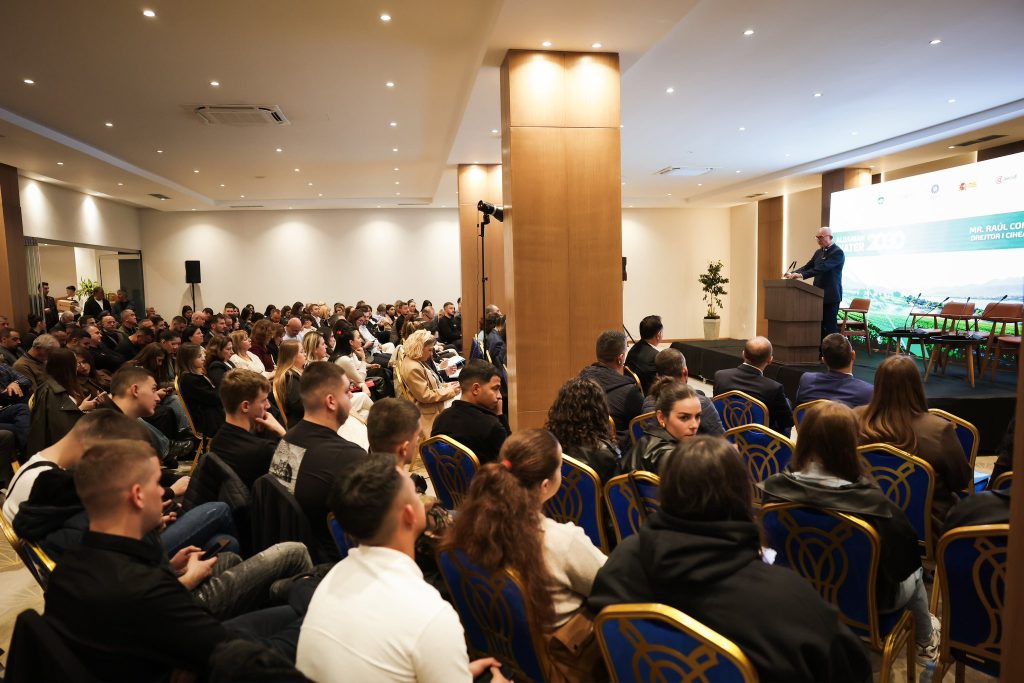
Sustainable water management, modernisation of irrigation systems, adaptation to climate change, and Albania’s priorities for the European integration process were among the key topics addressed during the international conference ‘Albania Water 2030 – Modernising Water Management and Irrigation Systems for a Resilient Albania’, held on 3 November in Durrës (Albania).
The conference was jointly organised by CIHEAM Zaragoza, the Embassy of Spain in Albania, the Ministry of Agriculture and Rural Development of Albania, and the Agricultural University of Tirana, with the presence of the Albanian minister of Agriculture and Rural Development, Andis Salla, and the Albanian minister of the Environment, Sofjan Jaupaj, together with representatives from institutions, international organisations, and universities together with experts from different European countries.
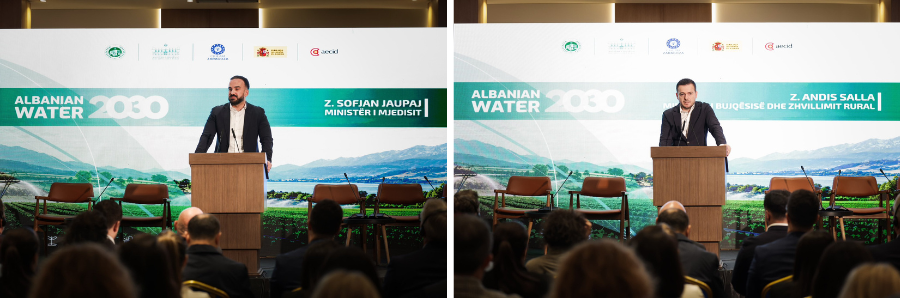
The conference delegates learnt more about the Spanish model of irrigation modernisation and discussed opportunities for knowledge and technology transfer to the Albanian agriculture sector, through contributions from CIHEAM Zaragoza, the Experimental Station of Aula Dei of the Spanish National Research Council (CSIC), and the Ministry of Agriculture, Fisheries and Food of Spain (MAPA).
The Spanish experience in modernising irrigation systems
Enrique Playán, research professor at the Experimental Station of Aula Dei (CSIC) and scientific coordinator of the International Master in Sustainable Water Management and Governance in Natural and Agricultural Environments run by CIHEAM Zaragoza, presented the Spanish experience in modernising, automating and digitalising irrigation systems to make them more efficient. He also provided scientific and technical insight to create opportunities for the transformation of the Albanese agriculture sector.
Inmaculada Bravo, specialist from the Spanish Ministry of Agriculture, Fisheries and Food, participated online, presenting the Spanish policy for modernising irrigation systems to adapt to climate change and strengthen the resilience of the sector.
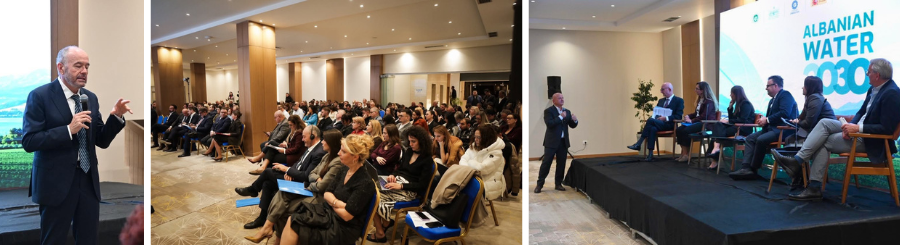
In addition, director of CIHEAM Zaragoza, Raúl Compés, moderated the high-level panel ‘Albania Water 2030: Priorities and Investments in the Water Sector towards 2030’, bringing together representatives from three Albanian ministries (Agriculture, the Environment, and Infrastructures and Energy), the Karlsruhe Institute of Technology in Germany, and the FAO in Albania.
The session addressed Albania’s priorities for the modernisation of water infrastructures, improvement of irrigation systems, protection of water quality, and compliance with European standards for drinking water and wastewater treatment.
Water: a strategic asset for sustainable development
The international conference lies within the framework of CIHEAM Zaragoza’s commitment to scientific diplomacy, connecting scientific knowledge, institutional cooperation, and policy dialogue to face global challenges.
In the scope of water, this task is particularly relevant given the shared challenges faced by Mediterranean countries in matters of water security, climate resilience, and sustainable management of natural resources.
The event has strengthened opportunities for collaboration with Albania, a CIHEAM Member State since 1992, to help the country achieve more efficient, sustainable, and resilient water management.