

- CIHEAM Zaragoza joins a cooperation project in the Bay of Sechura in Peru to transform marine aquaculture waste into resources for regenerating agricultural soils.
- Based on a firm commitment to gender equality, the initiative will strengthen women’s participation throughout the value chain and in decision-making processes.
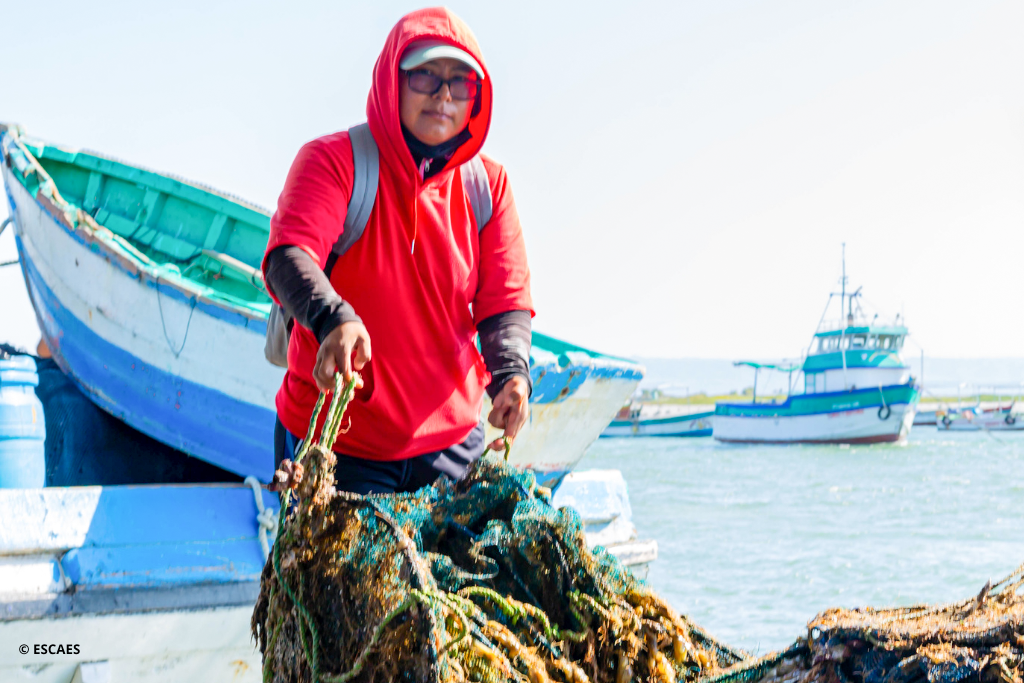
Marine aquaculture worker in the Bay of Sechura (Peru). Foto: ©ESCAES
3 August 2026.- Turning an environmental challenge into an opportunity for inclusive, equitable and sustainable development in the Bay of Sechura, northern Peru. This is the aim of the project funded by the Spanish Agency for International Development Cooperation (AECID), in which CIHEAM Zaragoza and its partner organisations will be working over the next two years (2026-2028).
The initiative will facilitate the transition towards a more sustainable aquaculture sector in this coastal region while strengthening the leadership of women working in aquaculture and helping to reduce gender inequalities. It will do so by favouring equitable and sustained access to natural resources, technology and finance, while ensuring a fairer distribution of benefits and responsibilities.
In a context where production is heavily dependent on the Peruvian scallop in an environmentally sensitive ecosystem, the project proposes an alternative model based on circular economy, production diversification and participatory environmental governance.
A marine-coastal circular bioeconomy
Located in the northern Peruvian region of Piura, the Bay of Sechura is one of the country’s biggest producers of Peruvian scallops. While this production is an important driver of the local economy, it also generates significant volumes of waste that have become an increasing environmental concern. At the same time, women continue to face barriers to accessing resources, gaining visibility and participating fully in both the value chain and decision-making processes.
The project addresses these challenges by transforming aquaculture waste into bio-based products for regenerating agricultural soils and improving soil fertility in the region through a marine-coastal circular bioeconomy approach. These products will be manufactured in a community-run factory where women will play a leading managemental role and be engaged in the technical, organisational and commercial management of the value chain.
Production diversification and environmental governance
Beyond creating value from aquaculture waste, the project will diversify production beyond the Peruvian scallop by incorporating the cultivation of grooved carpet shell clams and seaweed. This diversification will provide more stable sources of income and increase opportunities for economic independence, particularly for women.
A third pillar of the initiative is the establishment of a local environmental governance framework bringing together public authorities, the productive sector and civil society. This collaborative platform will promote dialogue, strengthen shared responsibility for protecting the marine-coastal ecosystem and support more inclusive and equitable decision-making.
Capacity building
CIHEAM Zaragoza will play a key role in knowledge transfer and capacity building, contributing its extensive experience in international cooperation for sustainable food systems.
Its contribution will include training in circular bioeconomy, aquaculture and business management; supporting women’s participation in the management and governance of the biofactory; facilitating the implementation of innovative productive models and monitoring tools; strengthening local environmental governance; promoting knowledge-sharing with reference initiatives in Spain; and contributing to the project’s monitoring, evaluation, communication and dissemination activities.
An alliance linking science and development cooperation
CIHEAM Zaragoza is implementing the project together with Fundación Promoción Social and the University of Cadiz in Spain, and the Peruvian organisation Escuela Campesina de Educación y Salud (ESCAES). This international alliance will bring together science and cooperation to establish a development model that combines the conservation of marine ecosystems with new economic opportunities for local communities, while strengthening the leadership, autonomy and visibility of women working in aquaculture.