



Armed conflict and violence are among the primary drivers of acute food insecurity. Around one in six people worldwide were estimated to have been exposed to conflict in 2025, a year that saw the highest level of violence against civilians in the past five years. 80% of people living in acute food insecurity live in contexts of conflict or protracted crises.
Famines are not inevitable – they are almost always foreseeable, preventable and driven by human actions. Yet high levels of acute food insecurity have doubled over the past decade, with around 1.4 million people facing the most severe, or catastrophic, level of food insecurity in 2025.
Ensuring the right to food in conflict-affected contexts and protracted crises requires coordinated, forward-looking and people-centred approaches. Bridging conceptual and operational gaps is essential to strengthen principled, effective and context-responsive action, accountability, protect livelihoods and food systems, and promote locally grounded and sustainable pathways to recovery and resilience. These approaches are even more urgent amid reduced financing for humanitarian relief and the undermining of the very foundations of the United Nations and the international order.
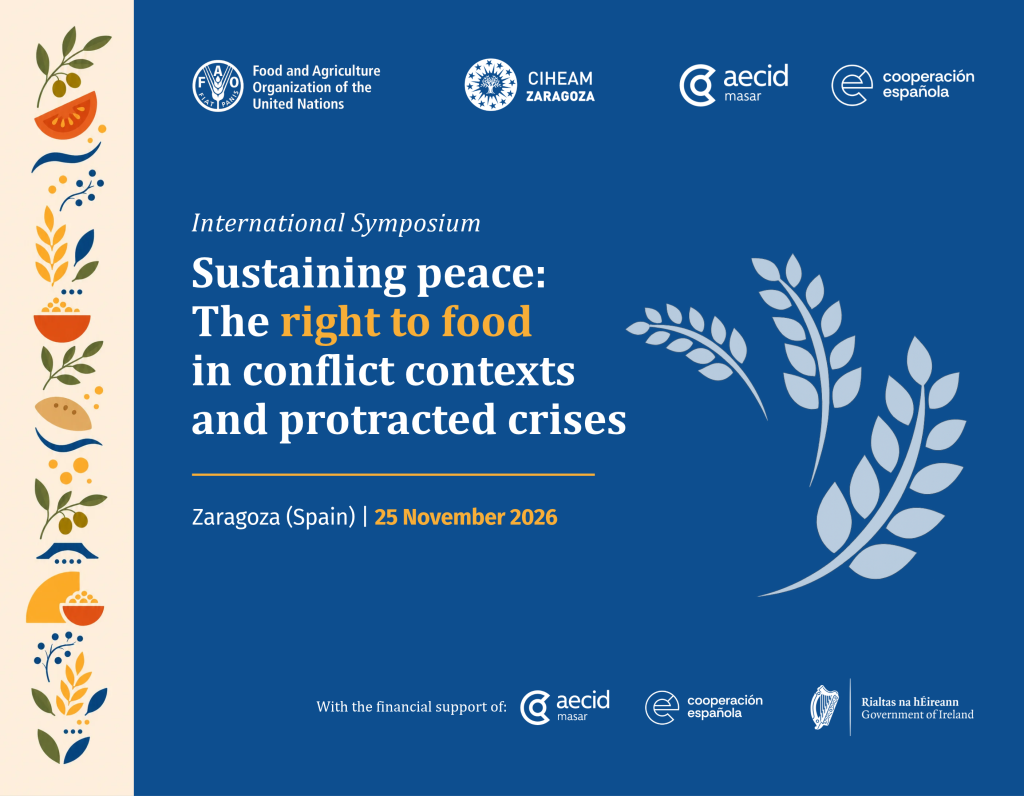
This is the focus of the International Symposium “Sustaining Peace: The Right to Food in Conflict Contexts and Protracted Crises”, co-organised by the Food and Agriculture Organization of the United Nations (FAO), CIHEAM Zaragoza and the Spanish Agency for International Development Cooperation (AECID). The Symposium will be held in Zaragoza, Spain, on 25 November 2026 in hybrid modality. Online and in-person attendance requires previous registration.
OBJECTIVES
The overall objective of the symposium is to strengthen understanding, awareness and capacity regarding the right to food in conflict contexts and protracted crises. It aims to address the policy, institutional and programmatic dimensions of the right to food. Finally, it seeks to identify concrete solutions to prevent hunger and food insecurity and to ensure the respect, protection and fulfilment of people’s rights, from early warning and risk prevention of violations of the right to food in conflict situations to rights-based, people-centred rebuilding, reconstruction and resilience.
Specific objectives:
• Raise awareness, strengthen understanding of the applicable international frameworks, and analyse the impact of conflicts and protracted crises on agrifood systems, while exploring reconstruction and peacebuilding models grounded in rights-based approaches.
• Strengthening dialogue and collaboration among human rights, humanitarian assistance, development and peacebuilding actors to enhance respect for, protection and fulfilment of the right to food in conflict contexts and protracted crises.
MAIN THEMES
The Symposium is structured around four interrelated thematic areas addressing the right to food in conflict contexts and protracted crises: strengthening early warning and anticipatory action; protection against gender-based violence and structural discrimination; examining environmental impacts and destruction of agrifood systems; and reinforcing international cooperation for people-centred recovery and reconstruction.
Theme 1: Prevention and early warning in conflict contexts and protracted crises
This theme analyses anticipatory action to prepare for, avert and prevent violations of the right to food in conflict contexts and protracted crises.
It will explore how to reinforce mechanisms to anticipate risks, issue alerts, and support preventive and responsive measures before food insecurity escalates into famine or systemic collapse. The discussion will also consider the roles and responsibilities of States, international organizations, humanitarian actors, development partners and local communities in strengthening prevention, preparedness and accountability.
Theme 2: Gender-based violence and structural discrimination
This theme examines how conflict and protracted crises disproportionately affect women and people in vulnerable situations.
It will explore how gender-based violence and structural discrimination undermine the realization of the right to food in conflict and protracted crisis settings, and how violations of the right to food increase exposure to gender-based violence and other forms of structural discrimination. It will identify integrated measures to strengthen protection, accountability and gender-responsive implementation of the right to food. The discussion will also focus on documenting resilience, highlighting community-led coping strategies.
Theme 3: Environmental degradation
This theme assesses the environmental impacts of armed conflict on the realization of the right to adequate food and their direct and lasting effects on agrifood systems.
It will explore the principal pathways through which environmental harm affects agrifood systems and the right to food, approaches to monitoring, documenting and assessing these impacts, and will consider how the environmental foundations of the right to food can be protected. It will also highlight how environmental harm becomes an increasingly causal factor in conflicts and protracted crises.
Theme 4: People-centred peace-building, reconstruction, and resilience
This theme reflects on the importance of international cooperation, and the centrality of the right to food in post-conflict processes. It will consider the application of human rights-based and people-centred approaches for inclusive, sustainable, accountable, and equitable agrifood systems’ reconstruction and recovery after conflict and during protracted crises to contribute towards lasting peace.
It will explore how recovery processes can strengthen linkages with protection and localization agendas and examine how affected communities, groups in vulnerable situations including marginalized and displaced groups, can participate meaningfully in decisions that shape recovery, reconstruction and resilience of their agrifood systems for effective peace building processes.
You can download the agenda here.
Co-organisers

Donors
