This project involves The CIHEAM Zaragoza institute
Project Summary
Agricultural intensification, required to feed the growing world population, may be constrained by limited water resources and increased environmental pollution of soils and waters in the Mediterranean region. In particular, irrigated agriculture may induce negative impacts on the quantity and quality of natural resources such as land degradation by salinization and sodification (“on-site” impacts) and increased salt and nitrate loads in irrigation return flows (IRF) and receiving water bodies (“off-site” impacts). Therefore, an environment-integrated management of these constrained water and soil resources is essential. Accordingly, the EU Water Framework Directive should be expanded to implement water-pollution regulatory standards and policies regulating the discharge and quality of IRF.
The aim of this project is to provide scientific, technical and socio-economic information on salt and nitrogen contamination, and on pollution control measures in Mediterranean irrigated agriculture. The project addresses the thematic issue B.1 (Environment) of the FP6-2003-INCO-MPC-2 call in activities B.1.1 (Comprehensive water policy and integrated planning) and, particularly, B.1.2 (Improving the water consumption efficiency and effectiveness by users and uses). Seven scientific partners and ten stakeholder participants (Water user Associations and Public Water Authority Institutions) from six different countries (Algeria, Morocco, Spain, Tunisia, Turkey and the United Kingdom) will participate for the four years of this project.
The main activities of the project will be: (1) input-output mass balances in representative irrigation districts and assessment of salt and nitrogen pollution effects of present agricultural management; (2) model simulation studies analysing potential best management strategies for pollution control; (3) evaluation of these strategies in selected pilot field trials (in particular: scheduling of irrigation, nitrogen fertilisation and reuse of drainage waters for irrigation); (4) socio-economic analysis of present agricultural management and of source-sink pollution control management alternatives; and (5) dissemination of results to water users and policy makers. Feedback with project end-users will take place via the participation of the stakeholders, thus ensuring that all relevant issues are properly addressed.
Coordinator
CIHEAM (International Centre for Advanced Mediterranean Agronomic Studies) – Spain
Source of funding : EUROPEAN COMMISSION 6th Framework Programme Programme and Contact references : FP6 INCO-CT-2005-015031 Total budget : 1,00 € Partners :
University of Stirling. Economics department. – U.K.
Department of Agricultural Structures and Irrigation. Faculty of Agriculture. Çukurova University – Turkey
Department of Hydraulics. Institut National Agronomique (INA) – Algeria
Soil Science Department. Institute of Agronomy and Veterinary Hassan II ( IAV HASSAN II) – Morocco
Department of Water Resources Management and Conservation- Institut National Agronomique de Tunisie(INAT) – Tunisia
An EU-wide farm network demonstrating and promoting cost-DESURVEY : A Surveillance System for Assessing and Monitoring of Desertification // DESURVEY //
This project involves The CIHEAM Zaragoza institute
Project Summary
DeSurvey is a project funded by the European Commission under the Framework Programme 6 and contributing to the implementation of the actions ‘Mechanisms of desertification’ and ‘Assessment of the vulnerability to desertification and early warning options’ within the ‘Global Change & Ecosystems priority’.
In spite of the relevance of appropriate actions to counter and to combat desertification, there is a lack of standardised procedures to perform them at operational scales. The DeSurvey project offers a contribution to fill this gap by complementing assessment of desertification status with early warning and vulnerability evaluation of the involved land use systems. In this context, the interactive effects of climatic and human drivers of desertification will be taken into account in a dynamic way.
The ambition of the DeSurvey consortium is to deliver a compact set of integrated procedures of desertification assessment and forecasting, with application and tutorial examples at the EU and national scales. The performance of DeSurvey in other desertification threatened areas of UNCCD regional Annexes will be also tested against other expertise and available procedures. Indeed, partners (and sites) from Maghrebian and Sahelian countries as well as from Chile and NW China are associate members of this project.
DeSurvey 39 partners representing 10 EU Member States and 6 Third Country States, integrate key research organisations and industrial companies with a wide range of skills. They develop an operational prototype that includes flexible procedures, with generic and case specific components to which users can adapt according their biophysical and socio-economic environments and their data availability. DeSurvey will support international, European, national and regional authorities, organizations and institutions in fulfilling their monitoring/surveillance and reporting obligations, and help them to increase the efficiency of desertification treatment policies.
Coordinator
Agencia Estatal Consejo Superior de Investigaciones Científicas – Spain
Source of funding : EUROPEAN COMMISSION 6th Framework Programme Programme and Contact references : GOCE 003950 Total budget : 10,00 € Partners :
University of Trier – U.K.
Research Instituut voor KennisSystemen – Netherlands
University of Leeds – U.K.
University of Cranfield – U.K.
Lund University – Sweden
Mediterranean Agronomic Institute of Zaragoza International Centre for Advanced Mediterranean Agronomic Studies – Spain
Universidade de Evora – Portugal
National Observatory of Athens – Greece
Istito Nazionale di Economia Agraria – Italy
Universidad de Castilla-la-Mancha – Spain
Aristotle University of Thessaloniki – Greece
King’s College London – U.K.
University Catholique de Louvain – Belgium
Humboldt-Universitaet zu Berlin – Germany
European Commision Directorate General Joint Research Centre Institute for Environment and Sustainability – Italy
Freie Universitaet Berlin – Germany
Universitat de Valencia Estudi general – Spain
Agricultural University of Athens – Greece
Instituto Superior de Agronomia – Portugal
Universidad Carlos III de Madrid Department of Economics – Spain
Chinese Academy of Sciences – China
National Agricultural Research Foundation Institute for Mediterranean Forest Ecosystems and Forest Products Technology – Greece
Forest research Institute – Greece
Agenzia nazionale per le nuove tecnologie, l’energia e lo sviluppo economico sostenibile – Italy
Deutsches Zentrum fur Luft und Raumfahrt e.V. – Germany
Centro Interdipartimentale di Ateneo-Nucleo Recerca Desertificazione Universita di Sassari – Italy
Departamento de Geografia e Planeamento Regional Faculdade de Ciencias Sociais e Humanas Universidade Nova de Lisboa – Portugal
GeoForschungsZentrum Postdam – Germany
Universidad de Almeria – Spain
Universidad de Chile – Chile
Centre de Recherches Forestires – Morocco
Institut des Regions Arides – Tunisia
Centre de Recherche Scientifique et Technique sur les Regions Arides – Algeria
This project involves The CIHEAM Zaragoza institute
Project Summary
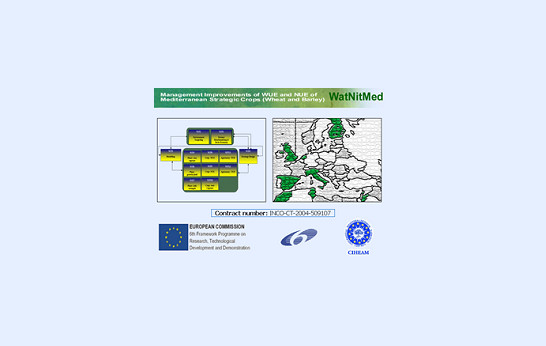
Water is recognized as the most limiting factor in Mediterranean regions, though N shortages seem as important as water scarcity. Breeding under these circumstances has been consistently funded by the EU-INCO programme. As crop productivity for a particular region is the consequence of the breeding x management x weather interaction, understanding the bases for improved management has been becoming increasingly important. The general objective of this proposal is to identify and transfer improvements in management of wheat and barley through increasing the capture and/or the use efficiency of water and N.
The project is based on the premise that understanding the physiological bases of the responses to water x N shortages would allow the design of more consistent management practices to overcome the deficiencies explored, either by directly using the concepts in such strategic design or by being able to build up (or adapt an existing) robust simulation models based on this knowledge and then allowing the testing of different alternatives exploring a large degree of G x E interactions. We aim to improve the understanding on the determinants of the crop ability to capture more water and/or to use water more efficiently in a range of N availability conditions; as well as to capture more N and/or to use N more efficiently in a range of water availability conditions.
In this case, both ranges will be characterized and described within the context of the project, (i) identifying plant/crop characteristics that may confer superior ability, (ii) building up a mechanistic simulation model used in the design of management strategies, (iii) testing agronomic hypothetical management strategies in these environments, and (iv) evaluating the socio-economic impact of the adoption of the improved strategies, and actually transferring the outcomes to the producers (with Farmers Associations in our partnership).
Source of funding : EUROPEAN COMMISSION 6th Framework Programme Programme and Contact references : INCO-CT-204 509107 Total budget : 1,00 € Partners :
CIHEAM (International Centre for Advanced Mediterranean Agronomic Studies) – IAMZ (Mediterranean Agronomic Institute of Zaragoza) – Spain
Lebanese Agricultural Research Institute (LARI) Department of Irrigation and Agro-Meteorology – Lebanon
Agronomic Higher Institute of Chott Meriem (ISA-CM). Dept. of Rural Development-Agricultural Economics – Tunisia
Crop and Weed Ecology. Wageningen University (Wageningen-UR) – Netherlands
School of Bioscience, Division of Agricultural Science, University of Nottingham(UNOTT) – U.K.
Departament de Biologia Vegetal, Facultat de Biología, Universitat de Barcelona (UB) – Spain
Plant Production Research, Crops and Biotechnology. Agrifood Research Finland (MTT) – Finland
CIHEAM (International Centre for Advanced Mediterranean Agronomic Studies) – Istituto Agronomico Mediterraneo of Bari (IAMB) – Italy
Area de Conreus Extensius – Centre UdL-IRTA, University of Lleida (UdL) – Spain
University of Jordan, Faculty of Agriculture (UOJ) – Jordan
Institut National de la Recherche Agronomique de Tunisie (INRAT) – Tunisia
Institute National del la Recherce Agronomic (INRA) – Morocco
Union Tunisienne de l’Agriculture et de la Pêche (UTAP) – Tunisia
Association of Cereals Growers of Foggia (ASSOCER-FOGGIA) – Italy
This project involves The CIHEAM Zaragoza institute
Project Summary
The final objective of the Project is to provide Guidelines for Drought Preparedness Plans and the Framework for the setting up of a Drought Preparedness Network for the Mediterranean countries. The main contribution provided by these guidelines will be their adaptation to the physical and socio-economic environment of the Mediterranean countries and their elaboration following a common methodology. The overall objective of the proposed project is to increase the scientific background and knowledge on droughts, the types of drought, their onset and end, their frequency of occurrence, the water resources availability and water demand in relation to the climate, the water shortage observed and the impacts of water shortage caused by droughts in the six Partner countries. The hydrological drought and the agronomic drought, that mainly affects Mediterranean rainfed agriculture, will be differentiated.
Coordinator
INMEDITERRANEAN AGRONOMIC INSTITUTE OF ZARAGOZA IAMZ-CIHEAM – Spain
Source of funding : MEDA Water Programme and Contact references : ME8/AIDCO/2001/0515/59770 – P 027 Total budget : 3,00 € Partners :
UNIVERSITY OF CATANIA DEPARTMENT OF CIVIL AND ENVIRONMENTAL ENGINEERING – Italy
NATIONAL TECHNICAL UNIVERSITY OF GREECE – Greece
UNIVERSITY OF CYPRUS DEPT OF MATHEMATICS AND STATISTICS – Cyprus
MINISTÈRE DE L’AGRICULTURE, DE L’ENVIRONNEMENT ET DES DG\B.G.T.H. – Tunisia
IAV HASSAN II NATIONAL DROUGHT OBSERVATORY, CENTRAL UNIT – Morocco
CONFEDERACIÓN HIDROGRÁFICA DEL TAJO OFICINA DE PLANIFICACIÓN HIDROLÓGICA – Spain
CANAL DE ISABEL II DPTO DE TECNOLOGÍAS APLICADAS – Spain
FUNDACIÓN ECOLOGÍA Y DESARROLLO – Spain
Gestionar consentimiento
Para ofrecer las mejores experiencias, utilizamos tecnologías como las cookies para almacenar y/o acceder a la información del dispositivo. El consentimiento de estas tecnologías nos permitirá procesar datos como el comportamiento de navegación o las identificaciones únicas en este sitio. No consentir o retirar el consentimiento, puede afectar negativamente a ciertas características y funciones.
Funcional
Always active
El almacenamiento o acceso técnico es estrictamente necesario para el propósito legítimo de permitir el uso de un servicio específico explícitamente solicitado por el abonado o usuario, o con el único propósito de llevar a cabo la transmisión de una comunicación a través de una red de comunicaciones electrónicas.
Preferencias
El almacenamiento o acceso técnico es necesario para la finalidad legítima de almacenar preferencias no solicitadas por el abonado o usuario.
Estadísticas
El almacenamiento o acceso técnico que es utilizado exclusivamente con fines estadísticos.El almacenamiento o acceso técnico que se utiliza exclusivamente con fines estadísticos anónimos. Sin un requerimiento, el cumplimiento voluntario por parte de tu proveedor de servicios de Internet, o los registros adicionales de un tercero, la información almacenada o recuperada sólo para este propósito no se puede utilizar para identificarte.
Marketing
El almacenamiento o acceso técnico es necesario para crear perfiles de usuario para enviar publicidad, o para rastrear al usuario en una web o en varias web con fines de marketing similares.