


- The Olive Oil World Congress (OOWC) was held in Lisbon, bringing together almost 380 professionals from 43 countries to discuss innovation, health, and the future of the olive sector.
- CIHEAM Zaragoza has been involved since the beginning of the initiative, playing a prominent role in organising the event and designing the scientific programme.
The Olive Oil World Congress (OOWC) held its second edition in Lisbon on 2 and 3 July. This biennial event has become the leading international forum for the olive and olive oil sector. Almost 380 professionals from 43 countries gathered in the Portuguese capital, alongside ministers José Manuel Fernandes (Portugal), Anton Refalo (Malta), Rezq Salimiya (State of Palestine) and Rana Tanveer Hussain (Pakistan); the Executive Director of the International Oil Council (COI), Jaime Lillo, and the Regional Minister for Agriculture, Livestock Farming and Rural Development of Castile-La Mancha, Julián Martínez Lizán.
CIHEAM Zaragoza has supported the initiative since the first edition of the OOWC in 2024, strengthening its contribution in the second edition: CIHEAM Zaragoza Director Raúl Compés chaired the Congress Organising Committee, while Ramzi Belkhodja, Head of Training at CIHEAM Zaragoza, repeated his role as chair of the Scientific Committee. Belkhodja explained that the OOWC scientific programme of the OOWC was designed through an integrated and participatory approach, combining high-level presentations with round table discussions that facilitated the exchange of perspectives and went on to say that the format was conceived to advance practical solutions to the main challenges facing the olive and olive oil sector across the whole value chain.
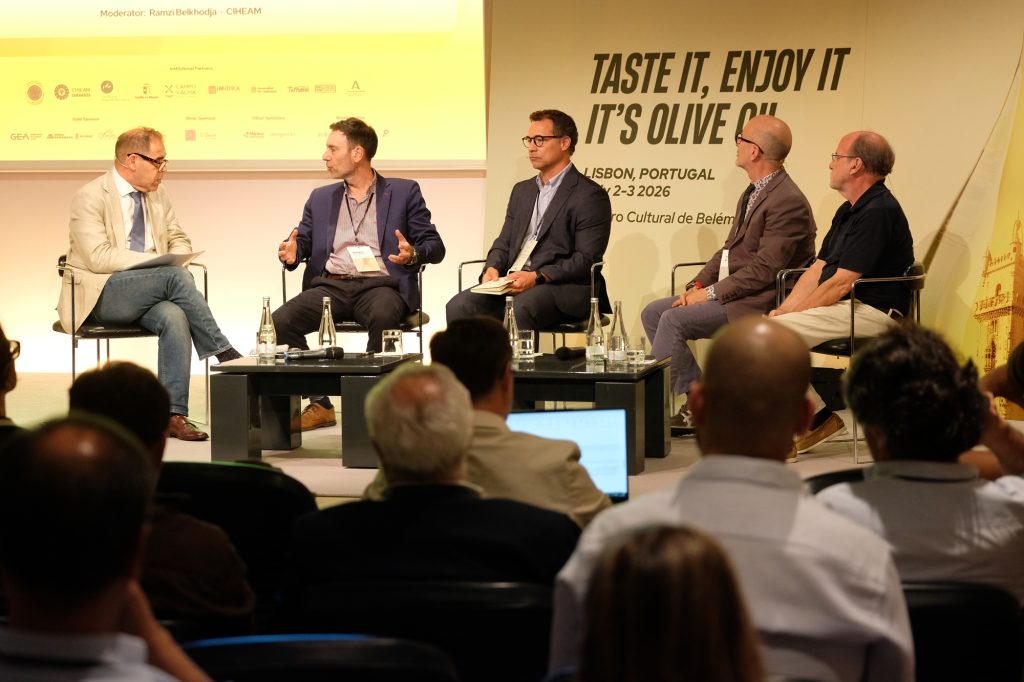
Belkhodja also moderated the closing round table, "Challenges for Innovation in Olive Growing and Olive Oil", with panellists Gonçalo Moreira (Olivum), Joseph R. Profaci (NAOOA), Georgios Koubouris (ELGO Dimitra), and Ramón Estruch (University of Barcelona).
CIHEAM Zaragoza, over thirty years of commitment to the olive sector
CIHEAM Zaragoza’s involvement in the OOWC is not an isolated initiative, but the natural continuation of more than three decades of commitment with the olive sector. In 1995, the institution joined forces with the University of Cordoba, the International Olive Council, the Spanish National Research Council, the Regional Government of Andalusia and the Fundación Patrimonio Comunal Olivarero to create the International Master in Olive Growing and Oil Technology. Over the last thirty years, the master’s programme has trained over 350 professionals and researchers from 25 countries, consolidating a genuine international community around olive growing and oil production. This prestigious postgraduate training programme is complemented by a wide range of advanced courses designed together with the IOC and other institutions in Spain, Tunisia, Morocco and Türkiye, to address different challenges such as climate change, efficient water use, plant health and olive oil marketing strategies.
This long-standing commitment with the sector has led CIHEAM Zaragoza to become a natural partner of the OliveOil World Congress and has consolidated its presence in the leading international forums dedicated to olive growing and olive oil production.
Innovation, health and international cooperation
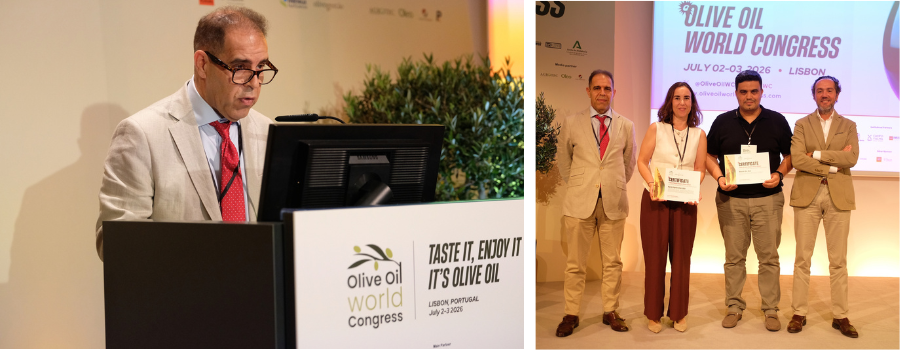
Discussions during the two-day Congress focused on the transformative impact of artificial intelligence on the olive sector, adaptation to climate change, scientific evidence concerning the health benefits of extra virgin olive oil (EVOO), and strategies for expanding global markets.
The opening address was delivered by scientist Fabrice DeClerck, who presented olive oil as a model of reference in the transition towards healthier diets and the importance of olive groves as agricultural systems that can enhance carbon sequestration and biodiversity through regenerative farming practices.
The second day of the event focused on innovation. Experts agreed that artificial intelligence is among the technologies being adopted most rapidly in olive production. Digital farm-management platforms now support fieldwork planning and other operations that, until recently, were beyond the reach of most olive growers. The programme also examined the circular economy, including the conversion of by-products such as olive pomace, olive mill wastewater and olive stones into new sources of added value; adaptation to climate change through advanced genetics and smart irrigation; and strategies to strengthen the international positioning of EVOO.
Jaime Lillo, Executive Director of the IOC, noted that one of every three litres of olive oil produced in the Mediterranean is now consumed outside the region, making international cooperation a strategic imperative for the sector.
Towards the Lisbon Declaration
One of the Congress’s main outcomes was the launch of the process leading to the Lisbon Declaration. Conceived as a consensus-based roadmap for the global olive sector, the Declaration will draw on scientific presentations, technical discussions and institutional exchanges held during the Congress and remains open to further contributions from participating experts and countries. It is founded on a central principle: that the contribution of olive oil to human health is its greatest value to society. Supported by decades of scientific research, this principle should help guide public policy, research priorities and sectoral communication.
Portugal accounted for the largest national delegation, with 124 professionals, followed by Spain, with 84. The Congress also welcomed representatives from olive-producing countries including Morocco, Italy, Greece, Tunisia, Algeria, the State of Palestine, Jordan, Egypt, Lebanon and Iran, as well as from current and prospective markets such as Malaysia, the United States, Germany, Brazil, the Netherlands, Chile, Nigeria, Argentina and Australia.
Participants included a delegation from Women in Olive, the international network promoting women’s leadership in the sector. During the event, the OOWC and Women in Olive announced the beginning of a collaboration that will lead to joint initiatives over the coming months.
The OOWC received institutional support from the IOC, CIHEAM Zaragoza and the Mediterranean Diet Foundation. It was also supported by public bodies including Portugal’s Ministry of Agriculture and Maritime Affairs; the Regional Government of Castile-La Mancha through its 'Campo y Alma' quality label; the Generalitat de Catalunya, the Regional Government of Andalusia; and the Madrid Institute for Rural, Agricultural and Food Research and Development (IMIDRA), as well as strong backing from the private sector.
This second edition confirms OOWC’s position as a leading international forum and marks a new stage in the development of the Lisbon Declaration. The Declaration is intended to become a framework of reference to strengthen international cooperation and address the principal challenges facing the olive growing sector.