


- The international symposium ‘The Farmers of Tomorrow’ brought together some 40 speakers and 100 guests in Zaragoza, Spain, on 30 September and 1 October 2026.
- The symposium analysed how economic, labour, social, institutional and territorial factors shape entry into and continuation in agriculture across the Mediterranean, with particular attention to young people and the future of family farming.
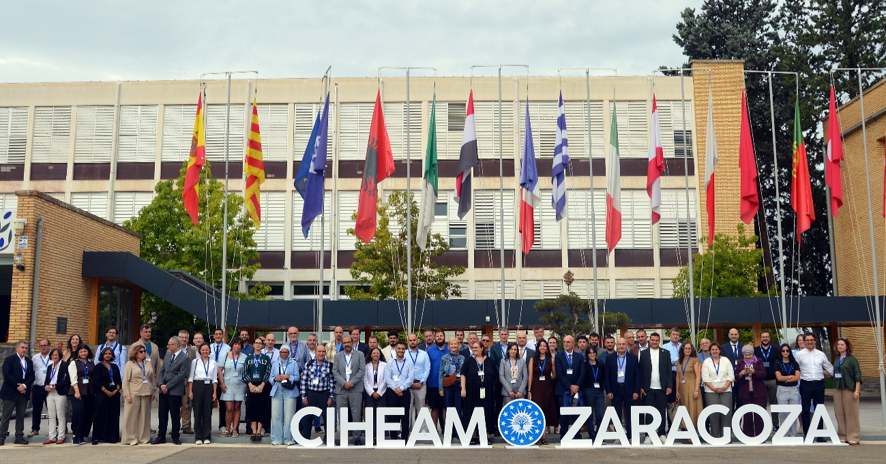
CIHEAM Zaragoza, in collaboration with the Spanish Agency for International Development Cooperation (AECID) and the SafeHabitus project, organised the international symposium ‘The Farmers of tomorrow: Skills, jobs and renewal pathways in times of uncertainty’ in Zaragoza on 30 September and 1 October 2026.
Agriculture, as the backbone of broader agri-food systems, is undergoing a deep structural transformation that raises urgent questions about its economic, social and territorial sustainability. Generational renewal, farm succession and the attractiveness of agricultural careers are not purely demographic issues. They are shaped by employment conditions, access to productive resources, organisational models, rural living conditions and changing societal expectations. Across the Mediterranean these dynamics take different forms, which is why uniform solutions fall short.
The symposium offered an evidence-based space to analyse how economic, labour, social, institutional and territorial factors interact to shape the attractiveness of the agricultural sector, with particular attention to young people and the future of family farming. It brought together some 40 speakers and 100 invited guests, including policymakers, researchers, sector stakeholders, youth and women representatives and civil society organisations from the Mediterranean and beyond.
The symposium also brought together more than 20 young farmers and representatives from 12 countries – Malta, Portugal, Jordan, Türkiye, Greece, Tunisia, Egypt, Algeria, Lebanon, Albania, Slovenia and Spain – who were invited to contribute their experiences, ideas and perspectives to the discussions. Their participation continued through a dedicated side event on 2nd October, the Mediterranean Youth Farmers Lab, which provided a space for further exchange, networking and collective reflection on the future of farming in the Mediterranean.
Opening session: ‘The future of farming: Who will farm? And under what conditions?’
The opening session of the symposium brought together representatives from 46 countries, both in person and online, to address the future of agriculture and the challenge of generational renewal. In his welcome address, Raúl Compés, Director of CIHEAM Zaragoza, highlighted the importance of attracting young people to farming and ensuring that agriculture remains a viable and rewarding profession. He outlined five key dimensions of this challenge: economic viability, skills and training, social and cultural conditions in rural areas, organisational and technological change, and institutional and policy support. He also stressed the need to reconcile agricultural modernisation with the preservation of a dynamic, economically sustainable farming sector.
Representatives of the Spanish Ministry of Agriculture, Fisheries and Food (Isabel Bombal Díaz, Director General for Rural Development, Innovation and Agri-food Training), the Government of Aragon (Ángel Ubieto, Director-General for Rural Development) and AECID (Cecilia García Gasalla, Director of Cooperation with Africa, the Arab World and Asia) highlighted the common challenges facing both shores of the Mediterranean, despite their different demographic realities. Their contributions emphasised the need to improve young people’s access to land, water, finance and knowledge, strengthen farm profitability, improve rural living conditions and promote women’s participation in agriculture and decision-making. They also presented policy measures and cooperation initiatives to support new entrants, facilitate farm succession and encourage the exchange of good practices. Their shared message was that generational renewal requires coordinated institutional action and an agricultural sector that offers young people a genuine and attractive professional future.
Marwan Benali (FAO) then set the scene with an overview of the status of youth and women in Mediterranean agri-food systems.
Round Table I: ‘The economics of farming: profitability, land and access to resources’
Moderated by Vicente Pinilla (University of Zaragoza), with Elena Schubert (DG AGRI), Faten Adada (FAO), Tomás García Azcárate (CEIGRAM-UPM) and Mario Béjar Fuentes (CEJA).
The discussion placed economic viability at the heart of generational renewal. High entry costs, rising input prices, fragmented land, unstable markets and weak bargaining power make life hard for young entrants, and public support, while important, cannot replace long-term profitability. Access to land, finance, markets and social protection emerged as interconnected barriers. Speakers also stressed that farming needs to be presented and enabled as a modern, skilled and technology-intensive career, and that risk management and resilience are central to stable farm incomes.
Among the recommendations were an integrated support package for young farmers (finance, land, skills, extension, market access and social protection), greater transparency in value chains and land markets, and stronger producer organisations. Examples included FAO’s work with 34 faculties of agriculture in Egypt to strengthen entrepreneurship, as well as incubators, e-markets and online platforms supporting rural women.
Round Table II: ‘Work in agriculture: labour dynamics, skills and working conditions’
Moderated by Trisha Mandal (YPARD), with Elisenda Estruch Puertas (ILO), Jesús Antón (OECD), Fatmir Guri (Ministry of Agriculture and Rural Development, Albania), Sarah Bouzar (Ministry of Agriculture, Algeria) and Carlos Ruiz Ramírez (Oxfam Intermón).
Speakers agreed that sustainability cannot rest on job creation alone: decent work and occupational safety are a prerequisite for making farming attractive to young people. The workforce is shrinking and ageing, modern farming demands interdisciplinary skills, and attracting young people means tackling three hurdles: the sector’s attractiveness; access to land, capital, water and credit; and alignment between vocational training and field realities. Decades of national measures have not yet reversed the trend, and the panel called for different approaches for family farmers and for wage and migrant workers.
Models presented included Algeria’s ‘3 C’s’ framework (Connect, Coach, Capitalise), Albania’s youth capital and succession scheme, Aragon’s generational renewal framework, and the SafeHabitus Community of Practice on agricultural health and safety.
Case Studies I
Moderated by Raquel Álvarez Urdiola (CIHEAM Zaragoza), with Antoine Messéan (Terre de Liens) and Roberto Serrano (La Estiva Escuela de Pastoreo de Aragón).
Antoine Messéan, representing the French non-profit Terre de Liens, examined the critical bottleneck of land access for prospective farmers, proposing that farmland should be treated as a common good rather than speculative property. By mobilising ethical citizen investment, the organisation purchases agricultural holdings and leases them under secure tenures with environmental clauses, shielding newcomers from prohibitive capital costs while fostering agroecological transition and local food sovereignty.
In parallel, Roberto Serrano presented grassroots initiatives developed in the Pyrenean valley of San Juan de Plan, Aragon, which culminated in the establishment of a dedicated shepherd school: La Estiva School of Shepherds. This programme delivers formal, recognised vocational training to equip future pastoralists with traditional husbandry and modern land management techniques, revitalising rural communities and safeguarding mountain ecosystems. In the discussion with the audience, both speakers emphasised that citizen mobilisation, territorial engagement and systemic policy reforms are vital to ensuring the viability and resilience of tomorrow’s European agriculture.
Poster session: “Stories from the field: Meet the people shaping the future of agriculture”
The poster session, co-funded by CIHEAM Zaragoza and the Horizon Europe project SafeHabitus, brought a first-person perspective to the symposium, complementing the five roundtables at the core of the programme. It showcased innovative and transformative initiatives that reflect both the opportunities and the challenges of the Mediterranean agri-food sector. The posters told real stories from the field, including successes, difficulties and lessons learned, with experiences that can be replicated or serve as inspiration. The selected participants were Ana Marcén Murillo (Spain), Bledar Meta (Albania), Cécile Pérez-Raynaud (France), Imen Mefteh (Tunisia), Sergio Alejandro Urioste Daza (Spain), Engin Samet Dede (Türkiye), Nataša Bokan (Croatia) and Salem Ghanam (Egypt).
Round Table III: ‘Why choose farming? Rural living conditions and the choice to stay’
Moderated by David Meredith (Teagasc, SafeHabitus coordinator), with Javier Esparcia (Universitat de València), Mohamed Taher Sraïri (Hassan II Agronomy and Veterinary Institute), Carolina Llaquet (FADEMUR Aragón) and Majda Černič Istenič (ZRC SAZU).
The central message was that generational renewal is about creating the conditions in which people can choose agriculture as a viable way of life and remain in farming. Viable livelihoods come first, though barriers vary with gender, family background and migration status. Working conditions matter just as much: long and unpredictable hours, limited holidays and sick leave, and difficulties in balancing work and family life. Because a farm is both a workplace and a home, housing, services, social networks and cultural life, summed up in the idea of the ‘right to stay’, are part of the equation. Participants also challenged the assumption that young people are uninterested in farming.
Collective solutions were highlighted: the CAMPOASTUR replacement service in Asturias, AGRICALL’s multidisciplinary support for farmers in difficulty, and a territorial renewal project in Valencia’s wine sector. The panel’s priorities were access to land, finance and housing; better working conditions and social protection; investment in rural communities; and recognition of young people as active contributors to rural development.
Round Table IV: ‘Farming differently: technology, cooperatives and new business models’
Moderated by Lorena Tudela Marco (Agencia Agroa), with Ángel del Pino (Anecoop), Chadi Abdallah (CNRS-L, Lebanon), Ana Mamić (Bura Local Action Group in Croatia, funded under the EU’s LEADER framework) and Rachid Moussadek (INRA Morocco).
The panel argued that rather than a lack of jobs, there is a lack of opportunities for young people to build their own future. Cooperatives were seen as having a role beyond marketing, as platforms for services, innovation and farmer development, and as a way of offering young people a sense of belonging and flexibility. The main obstacles to adopting new technology are access to finance, weak extension services, the lack of a clear research strategy and profitability concerns. Speakers favoured co-innovation with farmers over top-down transfer, and technology that is affordable, easy to use and validated under real farming conditions.
Examples included Anecoop’s RELEVA programme, the Bura Local Action Group in Croatia, Morocco’s ‘One Million Hectare’ direct seeding project and the PRIMA-funded CAMA project. The rapporteur added a note of caution: new technologies and business models will only reverse rural decline if power balances, public policies and institutional support change alongside them.
Round Table V: ‘Enabling the next farmers: policies, partnerships and investment for agricultural renewal’
Moderated by Marwan Benali (FAO), with Stoyan Tchoukanov (European Economic and Social Committee), Carolina Gutiérrez Ansotegui (Ministry of Agriculture, Fisheries and Food, Spain), Eduardo Baamonde Noche (Cajamar) and Gloria Abouzeid (Ministry of Agriculture, Lebanon).
Speakers identified profitability, rather than access to credit, as the main bottleneck, and pointed to a Common Agricultural Policy (CAP) that still rewards historical references and makes access to land difficult for new entrants. Policies were described as arriving late, in silos and under budget pressure, and support was said to need tailoring to each stage of a young farmer’s path, from installation to consolidation. Collective action through cooperatives and associations was seen as giving young farmers scale, voice and resilience.
Recommendations included shifting support towards new entrants, protecting the agricultural budget in the next EU financial framework, improving land mobility (including a European land observatory), a favourable tax regime during the installation period, and integrated, stable support packages. Examples included the CULTIVA programme, local action groups, Cajamar’s innovation fund and cooperative initiatives in Lebanon.
Case Studies II
Moderated by Clara Guelbenzu (CIHEAM Zaragoza), with Alessia Mazzù (Cooperativa Coraggio), Marcos Garcés (sociologist and young farmer) and Mokhtar Bouazza (Gardens of Babylon, Algeria [online]).
The second case study session highlighted diverse pathways into modern agriculture across the Mediterranean basin, featuring practical experiences from Italy, Spain and Algeria. Alessia Mazzù of Cooperativa Coraggio detailed how young activists in Rome campaigned to secure a 30-year lease over 22 hectares of derelict municipal land, transforming it through agroecological practices, multifunctional farming and free vocational training for young people excluded from education or employment. In contrast, Marcos Garcés, a fifth-generation farmer from Teruel, Spain, demonstrated how generational succession within a traditional family holding worked through organic transition, soil conservation and circular economy methods. Complementing these on-the-ground models, Algerian agritech entrepreneur Mokhtar Bouazza presented Gardens of Babylon, an artificial intelligence decision-support platform designed to optimise irrigation in water-stressed contexts by framing resource conservation directly around farm profitability and yield stability.
Rapporteurs session: key takeaways from the symposium
Each round table had a rapporteur, who presented the key takeaways in this session: Michel Frem (CIHEAM Bari), Julio Urruela (CIHEAM Secretariat General), Raquel Álvarez (CIHEAM Zaragoza), George Prekatsakis (CIHEAM Chania) and Rubén Expósito (CIHEAM Zaragoza). Their takeaways point in a common direction: farming has to offer a credible livelihood, decent working conditions and a good place to live, and this calls for coordinated action across agricultural, labour, social, housing, education and rural development policies, with young people involved as partners in shaping them.
Closing session: ‘Looking ahead: Shaping the future of farming for the next generation’
The closing session of the symposium brought together institutional representatives and international organisations to synthesise the overarching pathways required for agricultural renewal across the Mediterranean and beyond. Alun Jones (CIHEAM Zaragoza) framed the transition around an interconnected ecosystem of solutions, highlighting the imperative of securing equitable access to land, water, capital, decent housing and vocational training, while underlining that public policies such as the CAP, needed to champion new entrants, women and innovation rather than historical land entitlements.
Luis Escorihuela (EUROCLIMA Programme, FIAP) stressed that generational renewal could not rely on market forces alone, pointing to international cooperation, robust public institutions and concrete instruments (such as public land banks and sustainability certification) to reverse steep demographic declines.
Giuseppe Provenzano, representing the Union for the Mediterranean (UfM), framed generational renewal and the central question of who will farm tomorrow as an overarching human development challenge centred on youth, education and women’s empowerment. He pointed out three critical pillars for Euro-Mediterranean cooperation: modernising higher education and vocational training to cultivate essential green skills, actively connecting academic research with practical agricultural entrepreneurship and business incubation and strengthening multilateral dialogue through shared regional platforms to scale up proven grassroots solutions.
Octavi Quintana, former director of PRIMA, concluded that addressing generational succession required embracing complexity, expanding collective scale through cooperatives to strengthen farmer bargaining power, eliminating redundant intermediaries and deploying frugal digital innovations alongside targeted communication to local and regional decision-makers.
Finally, Santiago Morán, representing AECID’s Masar Al’an programme, focused on the institutional and operational mechanisms needed to turn regional dialogue into tangible impact on the ground. He highlighted the vital role of sustained international partnership and development financing in supporting young agricultural entrepreneurs, bridging the gap between scientific innovation and viable farm businesses, and fostering resilient rural livelihoods across partner countries in the Mediterranean basin.
The symposium brought together experts, practitioners, policymakers, and youth and women representatives from across the Mediterranean to share evidence-based analysis and discuss policies, strategies and practices that can make agriculture more attractive, sustainable and innovative. It also sought to encourage young people to explore opportunities in the sector and to promote joint initiatives and stronger training and education programmes.