Protected areas (PA) have proven their value for the conservation of biodiversity, sites and their cultural values. The awareness of society regarding the preservation of Nature is expressed in many policies and conventions of international fora. In recent decades the surface area under protection has exponentially enlarged, reaching 15.4% of the terrestrial and inland water world surface. Nevertheless a bigger effort is needed to increase and better manage existing PA and networks, that has to be specially focused on the establishment of marine PA, that to date represent only 3.4% of the total marine surface.
Besides addressing the inherent complexity of managing natural systems, nowadays PA face additional pressure related to the increasing use of resources and global change. Therefore, the integration of PA in a wider landscape planning and management approach is becoming a key issue, where society plays an important role in the decision making process. This strategy demands the development and application of new methods and tools to reach the PA goal of becoming cornerstones of the sustainable use and development of our planet.
Zaragoza (Spain), 13-18 June 2016
Primary production in aquatic systems is mainly derived from algae. In the marine realm, algae sustain the production of a hundred million tons per year of marine fisheries and a large portion of the aquaculture production (seaweeds, molluscs, larval rearing, etc.), securing a stable human food supply. On a daily basis, a wide array of high-value substances derived from marine algae, such as phycocolloids and pigments, are commonly used. Diverse international agencies, such as FAO, predict a fast and sustained global growth of algal production during the forthcoming decades.
Gran Canaria (Spain), 13–17 June 2016
Sustainability is a fundamental policy concept in the fields of environment, economic and social development in rural areas. Agri-environment and rural development challenges have become key issues related to rural development and agricultural policies.
The Mediterranean countries face complex and diverse agri-environmental and rural development issues that include climate change, soil erosion and degradation, water scarcity, increase of forest fires and biodiversity loss. The World Bank estimates that the loss of productivity caused by land degradation in southern and eastern Mediterranean countries costs on average between 1000 and 1500 million dollars, annually.
Sustainability is a fundamental policy concept in the fields of environment, economic and social development in rural areas
Zaragoza (Spain), 16 – 20 May 2016
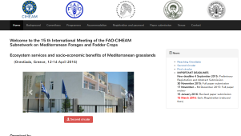
Mediterranean grasslands (including rangelands, pastures, meadows, fodder crops) are important resources with an area covering up to 48 per cent of the whole Mediterranean region. Although these ecosystems have traditionally played an important role in the evolution of human societies, and are still the key element in the production of high quality animal products they have been considered merely as a mean for providing feed for domestic ruminants.
Grasslands are essentially providing ecosystem services such as forage production, biodiversity conservation, habitat for wildlife, carbon fixation, prevention of erosion and nutrient storage. Despite their ecological, economic and social importance they receive limited scientific and media attention on their conservation merits. This is mainly because they are widely perceived as degraded land suitable only for grazing.
A major shift in grassland science has to occur, from considering their main function as pastures with a specific focus on livestock production to a much broader concept of ecosystem services management. Sustainable management should be about striking a balance among environmental conservation, livestock production and socio-economic development.
The FAO-CIHEAM Inter-regional Cooperative Research and Development Sub-Network on Mediterranean Forage Resources, together with the Democritus University of Thrace – DUTH (Greece), the Aristotle University of Thessaloniki – AUTH (Greece) and the Hellenic Range and Pasture Society – HERPAS and the Mediterranean Agronomic Institute of Zaragoza – IAMZ/CIHEAM (Spain), its 15th Meeting titled “Ecosystem services and socio-economic benefits of Mediterranean grasslands”. The Meeting will bring together scientists and specialists from countries of the Mediterranean regions, to present studies and to discuss research strategies and experiences allowing to face current challenges in grassland management.
15 th International Meeting of the FAO-CIHEAM Subnetwork on Mediterranean Forages and Fodder Crops (Orestiada, Greece, 12-14 April 2016)
Quality and safety control is a main topic for assuring food integrity that involves administration, industry and consumers. Analytical methods are essential to provide the required control, and molecular biology tools have become the key to address most of the related current issues throughout the whole food chain: authenticity, quality labels, safety and brand protection. The main advantages of molecular techniques for food safety and quality are the possibility to take strategic decisions just in time and the potential to adapt these methodologies to emerging needs with the same equipment and tools. Nowadays, these types of methodology are also easy to implement, offer robust results at a low time cost, provide solutions for very different types of analytical requirements, and exhibit in most cases the best cost/benefit ratio. International standards are commonly adopted by laboratories to guarantee their results. Molecular methods are increasingly being incorporated in accredited laboratories and are essential for a complete range of analytical methods.
Conservation Agriculture (CA) is a sustainable and profitable system of agricultural production and land management based on three interlinked principles: no or minimum mechanical soil disturbance, maintenance of soil organic cover, and crop diversification. CA has developed substantially worldwide over recent decades. Although the potential benefits of CA in Mediterranean conditions are high for farmers, society and environment, the system and its adoption and spread should be further optimized. With CA, production costs and negative environmental impacts can be minimized, while improving productivity and resilience, including climate change adaptation and mitigation.
This interactive course will address recent trends in CA practice and the major concerns that farmers face in the adoption of CA, which include the conflicts between animal and soil for the use of crop residues and the limited knowledge sharing and technical assistance.