MEDITERRANEAN AGRIBUSINESS SCHOOL (MABS)
Summer Program
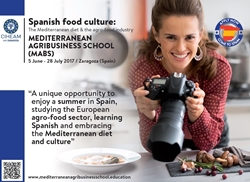
“Spanish food culture: the Mediterranean diet & the agro-food industry”
Zaragoza (Spain), 5 June – 28 July 2017
The MABS summer program will introduce students to the Mediterranean agribusiness environment focusing on the European Union (EU) as well as the culinary and cultural riches of Spain and will include Spanish lessons. It is a varied co-curricular program that reviews the main Mediterranean value chains -wine, olive oil, fruits and vegetables, seafood- with study trips to several cities in Spain, as well as visits to successful agro-food companies and activities in and around Zaragoza. This Study Abroad program will last 4 weeks with the possibility of staying an extra month to do an internship in a Spanish company.
This summer program is organized by the Mediterranean AgriBusiness School (MABS), an initiative run by IAMZ, one of the four Mediterranean Agronomic Institutes of the CIHEAM (International Centre for Advanced Mediterranean Agronomic Studies). The CIHEAM is an international intergovernmental organization – founded in 1962 at the joint initiative of the OECD and the Council of Europe– aiming to develop cooperation between Mediterranean countries through postgraduate training and promotion of cooperative research in the field of agriculture, food and sustainable rural development.
The program will introduce students to the Mediterranean agribusiness environment focusing on the European Union (EU) as well as the culinary and cultural riches of Spain and will include Spanish lessons too. It is a varied co-curricular program with study trips to different cities in Spain, as well as visits to successful agro-food companies and activities in and around Zaragoza. The program will last 4 weeks with the possibility of staying an extra month to do an internship in a Spanish company. Classes will be delivered in English and Spanish (with simultaneous interpreting into English for those who are not fluent in Spanish and prefer to follow the course in English).
This is a unique opportunity to enjoy a summer in Spain, studying the European agro-food sector, learning Spanish and embracing the Mediterranean diet and culture.
Apply now: MABS Summer Program
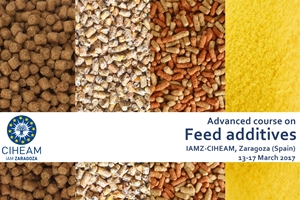
The International Centre for Advanced Mediterranean Agronomic Studies (CIHEAM), through the Mediterranean Agronomic Institute of Zaragoza (IAMZ), is organizing an advanced course on “Feed Additives” in Zaragoza (Spain) from 13 to 17 March 2017. The objective of this course is to provide participants with basic and applied knowledge regarding selected aspects of the use of additives in animal feeding. In this respect, the most recent information will be presented by recognized experts in the field of animal nutrition. For each of the additive group studied, the rationale, mode of action, current issues and new challenges will be covered. The programme will focus primarily on ruminants, poultry and pigs, but examples of other species will be included.
In March 2017, the Mediterranean Agronomic Institute of Zaragoza (IAMZ-CIHEAM) will host an international course on feed additives. Feed additives are used to complement the raw materials to fulfil animal requirements. The global market of these compounds is about 20 B$ and has increased steadily for the last 20 years. Feed additives cover many fields in animal production, from nutrition to animal health and food safety and quality. They are numerous and in many cases the mode of action has not been fully understood. Professionals need new knowledge and tools to find out which feed additive should be used, how and when. The European Union has defined five categories and 24 functional groups of feed additives, and they can be clustered in three main areas: additives that affect the quality of the ingredients and their digestibility (enzyme, toxin binders, fungi and bacteria inhibitors…), additives that are “building blocks” ready to be absorbed by the animal (amino acids, vitamins, trace elements…), and additives with an indirect effect on animal health (probiotics, prebiotics, phytogenics, acids…). Feed additives are very heterogeneous by nature and consequently, the mode of action, effects and benefits need to be addressed specifically.
The International Centre for Advanced Mediterranean Agronomic Studies (CIHEAM), through the Mediterranean Agronomic Institute of Zaragoza (IAMZ), is organizing an advanced course on the “Use of biosensors for food safety and quality” in Zaragoza (Spain) from 16 to 20 January 2017. This course provides comprehensive information about modern biosensors, their parameters, possibilities and limitations, along with the emerging technologies of their fabrication.
In January 2017, the Mediterranean Agronomic Institute of Zaragoza (IAMZ-CIHEAM) will host an international course on the use of biosensors for food safety and quality. Quality and safety of food products is a major concern of consumers and thus is one of the main challenges for a producer. Foodstuff comprises a great diversity of different products, each of which may have different hazards affecting its quality and safety. Biosensors play a crucial role in food control and analysis, providing relevant information on food-borne pathogens and contaminants and facilitating quality assessment. They also provide instrumental control necessary to comply with food European regulations. As compared with classical analytical methods, biosensors need smaller sample volumes, can be used for in-site on-line control and offer fast results allowing almost real-time decisions. Although most people can see the benefits of using the information provided by biosensors, this technology has not yet moved into the mainstream food processing industry. A better knowledge on the possibilities of these sensors and on their complementarity to other traditional analytical methods to achieve faster and more accurate results can enhance their adoption.
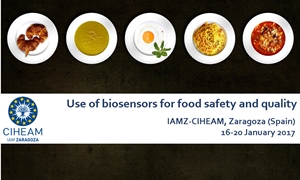
The International Centre for Advanced Mediterranean Agronomic Studies (CIHEAM), through the Mediterranean Agronomic Institute of Zaragoza (IAMZ), is organizing an advanced course on the “Use of biosensors for food safety and quality” in Zaragoza (Spain) from 16 to 20 January 2017. This course provides comprehensive information about modern biosensors, their parameters, possibilities and limitations, along with the emerging technologies of their fabrication.
In January 2017, the Mediterranean Agronomic Institute of Zaragoza (IAMZ-CIHEAM) will host an international course on the use of biosensors for food safety and quality. Quality and safety of food products is a major concern of consumers and thus is one of the main challenges for a producer. Foodstuff comprises a great diversity of different products, each of which may have different hazards affecting its quality and safety. Biosensors play a crucial role in food control and analysis, providing relevant information on food-borne pathogens and contaminants and facilitating quality assessment. They also provide instrumental control necessary to comply with food European regulations. As compared with classical analytical methods, biosensors need smaller sample volumes, can be used for in-site on-line control and offer fast results allowing almost real-time decisions. Although most people can see the benefits of using the information provided by biosensors, this technology has not yet moved into the mainstream food processing industry. A better knowledge on the possibilities of these sensors and on their complementarity to other traditional analytical methods to achieve faster and more accurate results can enhance their adoption.
CIHEAM Watch Letter No. 39 will be jointly published with FAO and will be focused on the Producer Organizations and Cooperatives for responsible investments and sustainable agricultural development in the Mediterranean.
CIHEAM and FAO invite junior and senior researchers, cooperators, development practitioners, journalists, any relevant representative from the international community and policy makers to submit papers that analyse and demonstrate the role of producer organizations and cooperatives for responsible investments and sustainable agricultural development, both at global level and in the Mediterranean countries.
Read the details of the call: Watch Letter 39
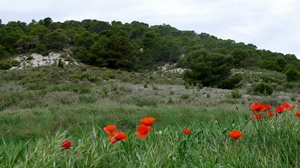
The International Centre for Advanced Mediterranean Agronomic Studies (CIHEAM), through the Mediterranean Agronomic Institute of Zaragoza (IAMZ), and the INFORMED project (INtegrated research on FOrest Resilience and Management in the mEDiterranean), with the collaboration of the Mediterranean Regional Office of the European Forest Institute (EFIMED), are organizing in Zaragoza an international course on concepts, methods and tools for an integrated approach of resilience in Mediterranean forests. The course will take place at IAMZ and will be taught by experts participating in the INFORMED project, coming from research centres and universities in different countries, and from EFIMED.
The aims of the course are: (i) to clarify the concepts needed to better understand the dynamics and functions of Mediterranean forest social-ecological systems; (ii) to give guidance on the use of available methods and tools needed to integrate knowledge from different disciplines; and (iii) to present good practices on the use of these methods and tools for informed decision making on forest management in the context of global change and related uncertainties.
This course is framed in the context of the INFORMED project (INtegrated research on FOrest Resilience and Management in the mEDiterranean. This research project develops a dynamic approach of the resilience of Mediterranean forests facing global change. Its scientific objectives are to fill gaps in knowledge on the basic mechanisms that determine the flexibility of the social-ecological system in response to disturbance; to integrate knowledge by combining different process-based models at various spatial and temporal scales; and to use integrated knowledge to develop management strategies as well as policy and governance guidelines to foster forest system resilience.
For more information on the course download the leaflet from IAMZ page and visit the project website.