Mycotoxins in cereal food/feed chains: prevention and control strategies to minimize contamination (Zaragoza, Spain, 22-26 January 2018)

In January 2018, the Mediterranean Agronomic Institute of Zaragoza (IAMZ-CIHEAM) will host an international course on mycotoxins in cereal food/feed chains. Cereals are a major component of human and livestock diets worldwide and mycotoxins are major natural contaminants in cereal food/feed chains. The consumption of mycotoxin-contaminated commodities is related to several acute and chronic diseases in humans and animals and thus has significant economic and social impacts. Many countries, including the EU, have strict legislative limits in place to minimize consumer exposure to these mycotoxins in food. Thus, mycotoxin contamination has an impact in both developing and developed countries and can affect the availability of staple cereals as well as influence the nutritional quality for human and animal consumption. Food insecurity may also increase in coming years due to climate change and therefore result in more significant mycotoxin related outbreaks in cereals.

This is a very timely course with a food chain approach integrating knowledge from different disciplines. It will contribute to the improvement of mycotoxin risk management and will be beneficial to key stakeholders in the cereal food and feed chains.

Smart farming, IoT and innovation kick off IAMZ’s 2017/2018 academic year

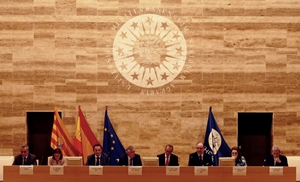
In attendance, at an event where IAMZ´s 50-year history in delivering quality education was recognised throughout the day, were senior officials from Spain’s Ministries of Foreign Affairs and Cooperation; Agriculture and Fisheries; Food and the Environment; and Education, Culture and Sports and representatives of the regional Government of Aragon and the main institutions in Aragon.

Mr. Jaime Haddad Sánchez de Cueto, Undersecretary of Spain’s Ministry of Agriculture and Fisheries, Food and the Environment and Mr. Joaquín Olona, Minister for Rural Development and Sustainability of the Government of Aragon, highlighted the 50-year old history of IAMZ and its capacity to train future leaders in the Mediterranean on food and agriculture. Senior officials from the Ministry of Foreign Affairs and Cooperation, the Ministry of Agriculture and Fisheries, Food and the Environment, and the Ministry of Education, Culture and Sports, also attended, together with representatives from the main institutions in Aragon and the Universities of Zaragoza, Córdoba and Alicante.

Following the welcome address, IAMZ Director Javier Sierra presented the training activities programmed for this academic year, stressing the importance of innovation and the new technologies in the agro-food sector and how both MSc programmes and advanced courses at IAMZ are constantly improving to reflect the latest trends.

During the event, two keynote speeches were delivered by J. Wolfert, scientific coordinator of the IoF2020 project and reputed researcher from Wageningen University speaking on how the internet of things and big data are transforming agriculture in Europe and José Mª de Lasala, Mercadona´s Director for Institutional Relations in Aragón and Castilla León, on Mercadona’s innovation model.

To conclude the event, the CIHEAM Award for the best MSc Thesis for 2016 was bestowed on Najla Ksouri, IAMZ 2014-16 student in Plant Breeding. The closing speech was delivered by Mr Jaime Haddad Sánchez de Cueto, Undersecretary of Spain’s Ministry of Agriculture and Fisheries, Food and the Environment.

VII International Master in Sustainable Fisheries Management in Alicante, Spain (October 2017 – June 2019)

Fishery resources are an excellent source of food as well as a driver of job creation in the coastal areas. According to the FAO, supply of fish for food from both capture fisheries (marine and inland) and aquaculture currently provides about 17% of the total supply of animal protein. At the same time, international trade of fish and fishery products has expanded significantly in the last decades, with about 36% of the production being exported. These statistics however do not reveal the concern about the current situation of fishery resources. If exploitation of these resources is to be both stable and sustainable in the long term, better management is required.

In order to obtain and interpret management-supporting data, experts with a multidisciplinary background are needed, that will address the issue from diverse perspectives such as biology, economics, sociology or law. In this way, they will be able to valuate and assess fishery resources and propose management measures through different techniques such as mathematical simulations, statistics, surveys, assessments or negotiation. Therefore, it is of maximum interest to train these experts so they can advise stakeholders in the diverse world of fisheries: different administrations (local, regional, state or supranational), fishermen (artisanal, semi-industrial or industrial), social groups (shipowners, trade unions, consumers, processors, fish farmers, etc.).

Furthermore, given the international scope of the marine environment, the need arises to establish a common method and language to be used between experts of the different countries sharing fisheries. To train specialists that can contribute to facilitating the search for cooperative measures from their respective countries to benefit all stakeholders is undoubtedly a great challenge that this Master addresses.

The MSc in Sustainable Fisheries Management is jointly organized by the University of Alicante (UA), the Spanish Ministry of Agriculture and Fisheries, Food and Environment (MAPAMA), through the General Secretariat of Fisheries (SGP), and the International Centre for Advanced Mediterranean Agronomic Studies (CIHEAM), through the Mediterranean Agronomic Institute of Zaragoza (IAMZ). Pending final confirmation, the General Fisheries Commission for the Mediterranean (GFCM) of the Food and Agriculture Organization of the United Nations (FAO) will also be part of the organization. Furthermore, the Master counts on the collaboration of the FAO Department of Fisheries and Aquaculture.

The Master is developed over two academic years on a full-time basis [120 credits, following the European Credit Transfer System (ECTS)], and is structured in two parts.

The first part of the Master (60 ECTS) is professionally oriented and is held in Alicante, in the Faculty of Science of the UA, from 10 October 2017 to 15 June 2018. The programme is delivered by highly specialized lecturers from the organizing institutions and distinguished guest lecturers belonging to international institutions and universities, research centres, administrations and private bodies from various countries.

The second part of the Master (60 ECTS) constitutes a period of initiation to research or to professional activity in which participants work on their Final Master Project (Master thesis). This part is conducted at the University of Alicante or other collaborating institutions and will last for 10 months, starting in September 2018. The first period for the defence of the thesis will be July 2019 and the second period will be September 2019.

Advanced course on monitoring environmental effects of aquaculture (Zaragoza, Spain, 18-22 September 2017)

In September 2017, the Mediterranean Agronomic Institute of Zaragoza (IAMZ-CIHEAM) will host an international course on monitoring environmental effects of aquaculture. Environmental monitoring techniques are important tools in understanding and managing the impacts of aquaculture. Recording environmental change over time is essential to conform to statutory environmental regulations and for the appropriate environmental management of aquaculture systems. However, there are many methods of monitoring such changes and these can vary between geographical regions or in approaches to effective environmental management of aquaculture.

The Mediterranean is a unique example of a water body which is shared by 22 countries with different economic and technological capabilities, legal frameworks and cultural traditions. However, the increasing pressure on marine resources and environmental assets necessitates a common understanding of the environmental risks and the harmonization of the regulatory schemes used across the Mediterranean. Existing regulations for the EU countries (e.g. Water Framework Directive) have imposed a certain degree of common practice in assessing environmental quality. However, it is important to take into account the problems and peculiarities of aquaculture over the entire Mediterranean Basin with an aim to establish a more robust and efficient way of ensuring the future of the industry in this area.

“Incentive 33” launched for International Agro-Food Marketing Master to celebrate 33 years

International Centre for Advanced Mediterranean Agronomic Studies (CIHEAM-IAMZ) in Zaragoza to celebrate 33 years of Master’s in Agro-Food Marketing with  special promotion campaign – “Incentive 33”. 

Led by US and International lecturers from some of the most prestigious agro-food Universities in the world, IAMZ provides one of the longest standing Master’s degrees of its kind in English with simultaneous interpretation into Spanish.  Students from across Europe, the Mediterranean and the rest of world have graduated from the course to lead agro-food business concerns in national and international entities or play key roles in the agro-food sector. The second year of the course includes a practical experience in a university or research center, while the student prepares their final Master’s Thesis.

The course counts on a teaching staff of 33 visiting professors from some of the top agro-food universities in the world, such as Cornell, Davis-California, Florida, Illinois, Massachusetts, Missouri, Penn State (USA) and Newcastle and Reading (UK) – 14 lecturers from the USA, 7 from UK and Eire and 12 other international lecturers from France, Germany, Spain and other countries. The course brochure and website are available here.

According to Javier Sierra, Director of the IAMZ, “The IAMZ is one of the few higher education institutes in the world offering this quality and pedigree in international agro-food education, in English for such an attainable price.  With 33 years of high quality academic excellence, the IAMZ, its lecturers and teaching methods clearly demonstrate the value of an International education in a vibrant Mediterranean setting.”

In addition to a number of places allocated to CIHEAM recipient countries, remaining places are now being opened up under “Incentive 33” during the 33 year Anniversary to fee paying students.  Representing probably the best value for money in the higher education agro-food market, the IAMZ is offering a limited number of places this year with a 33% fee reduction for Year 2 of the courseIncentive 33 will be valid for a limited time only. Compared to equivalent educational offers, course fees are highly advantageous and are fixed at 3,000 Euros per year.

The 2017-2018 academic course will be limited to 25-30 students receiving tailored instruction from approximately 33 international professors. Scientific coordination is led by one of Spain´s leading international agronomists and agro-food marketers, Dr. Luis Miguel Albisu. The Master provides a global and integrated vision of the components of agro-food marketing, placing emphasis on the international dimension of agribusiness marketing strategies. The comprehensive teaching system combines lectures, practical sessions, tutored group work, visits to firms and round table discussions with experts from firms in the sector. The International Master of Science is also recognized officially by the Spanish university system and is transferable across Europe.

The course is provided by the IAMZ, an international intergovernmental organization with a track record of more than 40 years in post graduate training and scientific research in the Agro-Food sector. Lying at the gateway to the Pyrenees, Zaragoza is the home of the 2008 World Expo and is less than 90 minutes by train from Barcelona and Madrid.

For further information:

E-mail: iamz@iamz.ciheam.org (please quote “Incentive 33”)

Tel: + 34 976 716 000

Link https://www.zaragoza.ciheam.org

iSAGE Newsletter is out: update on H2020 project on innovation for sustainable sheep and goat production in Europe

Sheep and goat sectors are of great importance both in Europe and in the Mediterranean, but have unique difficulties because they are generally located in rural, isolated areas. This is an opportunity because they can produce food from otherwise unused resources. Yet, the European and Mediterranean sheep and goat sector experiences many problems and faces many challenges such as climate change, low and fluctuating prices, consumption reduction, resource use efficiency and shrinking rural populations, with farmers becoming discouraged and leaving the  activity.

iSAGE, a research project funded by H2020, will try to turn these challenges into opportunities, by making the European sheep and goat sector more sustainable, competitive and resilient through strong collaboration between the industry and research institutions. IAMZ and EAAP are in charge of training, dissemination and stakeholders consultation activities in the project.

This newsletter features the main activities carried out during the first year of  iSAGE. You can download it here and visit the project website for more information here.