Raising awareness of the climate challenges in the Mediterranean: CIHEAM participates in COP27

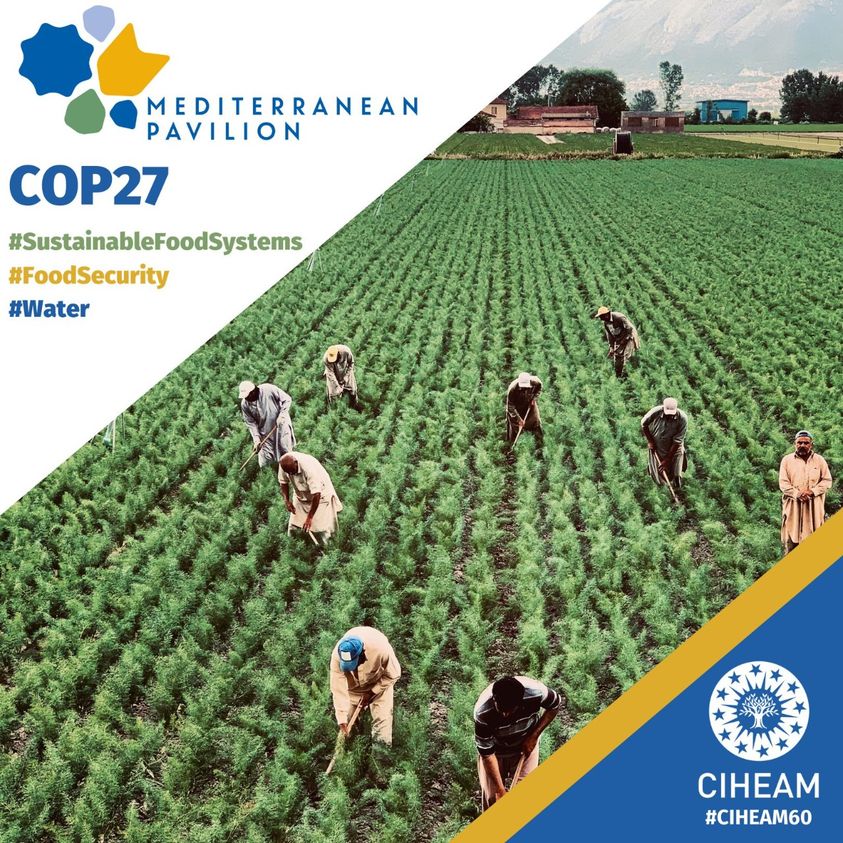
CIHEAM is pleased to announce that it will take part in COP27 (Egypt, 6-18 November 2022) which for the first time in history will host a Mediterranean Pavilion, seeking to highlight both the urgent challenges facing the region and the innovative solutions already being developed.

The Mediterranean Pavilion is a coalition of like-minded partners: the Union for the Mediterranean, the PRIMA Foundation, and UNEP–MAP, along with a number of relevant organizations and a scientific committee, led by the Mediterranean Experts on Climate and environmental Change (MedECC) network, which gathers 600 scientists, and produced the first scientific assessment on climate and environmental change in the region.

More information: www.mediterraneanpavilion.com.

Organisers

Partners

Scientific Council

We are hiring!

CIHEAM Zaragoza seeks proactive, resourceful professionals with good teamwork skills and committed to the Organization’s values and principles of  cooperative development, flexibility, capacity to adapt to the needs of society, internationality,  innovation, sustainability and constant pursuit of excellence.

CIHEAM Zaragoza offers the possibility to contribute to a passionate project based on international cooperation in agriculture, food, fisheries and the environment, and encourages an inclusive working environment and strives towards gender equality.

Have a look at the current vacancies at CIHEAM Zaragoza:

> Project Manager

Location: Zaragoza (Spain)

Deadline: 25 September 2022

Details: Vacancies at CIHEAM Zaragoza

>IT and Digitalization Specialist

Location: Zaragoza (Spain)

Deadline: 25 September 2022

Details: Vacancies at CIHEAM Zaragoza

>Executive Assistant

Location: Zaragoza (Spain)

Deadline: 25 September 2022

Details: Vacancies at CIHEAM Zaragoza

Seeking solutions in the Mediterranean to mitigate the impact of the cereal crisis: 9th MED-Amin annual meeting

The invasion of Ukraine has driven up already high global agricultural commodity prices. The consequences of expected disruptions in the delivery of Ukrainian grains and oilseeds are under scrutiny and speculations, with impacts already factual in many countries.  High input prices (including feed compounds, fertilizers) cast a serious shadow on future production, and thus add to already vivid concerns with global food security associated with record highs in food prices (grains-based products, vegetable oils…). The conflict in the Black Sea region highlights interdependences between food systems, energy markets, global peace and food security for all, as well as their fragility in many countries. The Mediterranean region is one of the most vulnerable to these shocks, and requires robust instruments and arenas to appreciate the crises consequences on grain and derived products markets.

Those global events also put high in the agenda the debate on alternative agricultural policies, regulation tools and cooperation mechanisms.

MED-Amin network, in its upcoming plenary session, offers the opportunity to experts and decision-makers around the Basin to debate those current issues, affecting Mediterranean food systems and food security, and open a ground for joint solutions. In particular, the current crisis puts in perspective the necessary momentum of the MED-Amin regional initiative.

In this context, the 9th edition of MED-Amin annual meeting will take place in Zaragoza on 22 and 23 November 2022 and will gather decision-makers of the CIHEAM Mediterranean countries and relevant international organizations as well as representatives of key operators of the grains market, to discuss relevant issues and leads for a strengthened MED-Amin Early Warning System, share updates on cereal markets and market forecasts, present MED-Amin 2021-2022 activities, and discuss upcoming planning.

For more information visit MED-Amin site.

Boosting the contribution of livestock and forage production for sustainable agrifood systems

The “Ruminant nutrition” and “Mediterranean pastures and forage crops” FAO-CIHEAM sub-networks organize a joint seminar in Catania (Italy) from 27 to 29 September 2022 to discuss alternative feed resources and their management for moving towards sustainable ruminant production. This seminar aims at exploring the various opportunities of novel or underexploited local feed resources, which could be valued better in the future and used to secure small ruminant feeding systems and boost animal production.

The Mediterranean basin is highly affected by climate change, while certain countries still need to increase livestock production in order to achieve food self-sufficiency, producing “better” is an urgent issue. In this respect, ruminants have an advantage as they can be fed on plants, plant parts and agro-industrial by-products which cannot be used directly for human consumption.

The Mediterranean landscape is made up of an agro-silvo-pastoral mosaic, which favours the interaction between livestock production, agriculture and natural areas. Mediterranean grasslands are an important source of forage; cultivated forage, possibly associated to perennial or annual crops, provides high-quality feed for periods of high nutrient requirements; the agro-industry produces a variety of typical by-products which may be included in ruminant diets.

For more information, visit https://faociheam2022.org/

New advanced course on recyclable, biodegradable, active and intelligent food packaging

The Mediterranean basin is one of the most relevant areas for food production and thus an important base for the economy of the countries. Packaging materials play an important role in commercialization, distribution and marketing. Traditionally, plastics have been the most abundant food packaging materials. However, the environmental problems created by plastic waste force the European Commission to search for new solutions that involve recycling and the search of new biodegradable and compostable materials in order to reduce the plastic waste. Although these are important objectives under the Circular Economy concept, there are many challenges to cope with when designing and selecting the materials to be in contact with food.

There is a wide range of plastics and the recycling processes are not always ready for all of them. The industrial sector is continuously developing new recycling solutions to provide safe materials that comply with the requirements (barrier properties, mechanical performance and visual appearance, among others) for each target food, but there is still a long way to go. This course will present and discuss issues related to the implementation of recycled materials.

In an effort to reduce conventional plastic use, an alternative could be the use of biodegradable and compostable materials. Again, these options need to be well designed and optimised. Some of them are industrially processed, but the applicability in food packaging is still limited to specific food products. In this course, we will describe the different materials available and their advantages and drawbacks.

FAO estimates that today, globally, roughly 33% (by weight) of the edible parts of food produced for human consumption is lost or wasted. Food is perishable due to physical, chemical or microbiological deterioration. Packaging is an important element in reducing food waste. Active and intelligent packaging technologies can maintain the quality and freshness of the products thus extending the shelf-life, contributing to reduce food waste, and facilitating commercialization and export. This course will give an overview of these technologies and provide some examples of their use, including commercial applications.

Organizer: CIHEAM Zaragoza

Venue: CIHEAM Zaragoza (Spain)

Dates: 14-18 November 2022

Modality: face-to-face & online

Details and registration: Recyclable, biodegradable, active and intelligent food packaging

CIHEAM Zaragoza is now a member of the ‘Círculo Agroalimentario de Aragón’

Círculo Agroalimentario de Aragón (Aragón’s agrifood circle) is an initiative of the General Directorate for Agrifood Innovation and Promotion of the Government of Aragon, with the purpose of bringing together the main stakeholders of the agrifood ecosystem to enhance the sector and give added value to the region’s produce. This open innovation and networking community strives to develop a powerful brand and develop the enormous potential of this strategic sector for the economy and the territory.

The Circle has over 250 members, both public and private entities that share common objectives and work in a collaborative environment to enhance the region’s agrifood brand.

Aragón is a big player in food production and processing. Many Aragonese products boast differentiated quality through schemes such as Protected Designations of Origin, Protected Geographical Indications, Quality labels, Organic Production, and Integrated Production, etc.

To learn more about the activities of the Círculo Agroalimentario de Aragón and share the secrets of Aragon’s food products, visit their website: https://www.comparteelsecreto.es/