Visit to CIHEAM of José Manuel Albares Bueno, Spain’s Ambassador in France

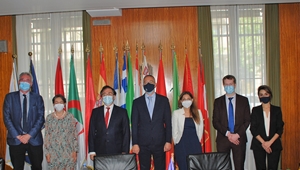
CIHEAM Secretary General, Mr Plácido PLAZA, has welcomed Mr José Manuel Albares Bueno, Ambassador Extraordinary and Plenipotentiary of the Kingdom of Spain to the French Republic and Ms María José Hernández Mendoza, Counsellor of Agriculture, Fisheries and Food to the Embassy of Spain in France and Delegate of Spain to CIHEAM.

The visit was held in Paris at CIHEAM headquarters and marked the opportunity to affirm Spain’s support of the intergovernmental organization, and reiterate the authorities’ support in priority fields of action, in particular gender inclusion and empowerment of women in food production systems and rural areas. Ambassador Albares stated the importance of this question for his country and for the Minister of Agriculture, Mr Luis Planas Puchades, who has made the role of women in agriculture one of his priorities.

Cooperation and dialogue in the Mediterranean

The ambassador congratulated CIHEAM on their commitment in this matter and in the inclusion of young people – recalling that CIHEAM has acted as a Mediterranean Erasmus in the field of animal and plant health for almost 60 years. He went on to assure the Secretary General of his full support in essential issues such as Mediterranean cooperation and dialogue and the European Neighbourhood Policy.

Another matter discussed was the work currently under way for CIHEAM’s accession to the delegated cooperation mechanism of the European Union. In order to operate for the EU several challenges must be met in relation to good governance, in particular in terms of transparency, accountability, responsibility and ethics. CIHEAM’s efforts in this sense have been commended by the ambassador.

An online exchange was also held with the Director of the Institute of CIHEAM Zaragoza, Raúl Compés, who presented the Institute’s activities, highlighting the topics related to water, plant and animal health, and youth employability.

Mr Compés informed the ambassador that on 8 June, he would be welcoming a delegation from the Spanish Ministry of Foreign Affairs and Cooperation and the Spanish Ministry of Agriculture, Fisheries and Food, thus reinforcing the chapter of cooperation and development in forthcoming years.

Spain is one of the founding countries of CIHEAM and hosts one of the Institutes in Zaragoza in Aragon.

Meeting between the Director of CIHEAM Zaragoza and the Rector of the University of Zaragoza

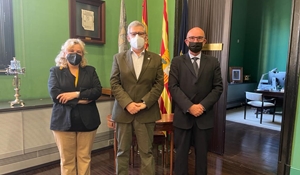
On 6 May the Director of CIHEAM Zaragoza, Raúl Compés, visited the Rectorate of the University of Zaragoza for a meeting with José Antonio Mayoral, Rector of the University of Zaragoza and Rosa María Bolea, Vice Rector of Political Science. During the meeting they reviewed the situation of joint activities and analysed future opportunities for collaboration. At present, for instance, CIHEAM Zaragoza and UNIZAR share the Master in Animal Nutrition, whose 8th edition will start in September of this year. There is a clear understanding between the parties and interest in exploring further opportunities based on the mutual confidence and complementaries between both institutions.

What actions for more sustainable food systems in the Mediterranean?

The UN Secretary-General has called for a Food Systems Summit to unleash the power of food and deliver progress on all 17 Sustainable Development Goals (SDGs). During preparatory summit dialogues, diverse stakeholders are invited to identify ways and actions to make food systems more sustainable.

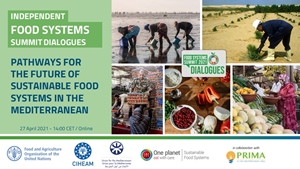
The CIHEAM; the FAO; the UfM; the UN One Planet Network Sustainable Food Systems Programme, in collaboration with the PRIMA Foundation, are organising two Food Systems Summit Dialogues ( 27 April and 3 June 2021) aiming at advancing a common understanding of the complex environment of Sustainable Food Systems in the Mediterranean region (SFS MED).

The objectives of this first Dialogue are:

  • Ensuring a deeper understanding of the interconnections and interdependences within Mediterranean food systems at every stage (from production, processing, distribution, marketing to the consumption of food, including food waste), based on consolidated scientific evidence and local knowledge;
  • Catalysing joint action, using the Mediterranean Diet as a lever to improve the sustainability and resilience of Mediterranean food systems, by bridging Sustainable Consumption and Production (SCP);
  • Engaging a wide network of food systems stakeholders within the broader frameworks of green, blue and circular economy, to design future scenarios of sustainable food systems in the Mediterranean region.

All the details here: https://www.ciheam.org/agendas/pathways-for-the-future-of-food-systems-in-the-mediterranean/

A methodological approach to food sustainability assessment: Course summary

A high-level training course was organized online from 15 to 24 February 2021 by CIHEAM Zaragoza to explore a methodological approach to food sustainability assessment. The course brought together more than 60 professionals from all over the world – 20 countries. Likewise, it counted on the participation of top international experts from the FAO, universities and research centres, and provided one of the most comprehensive expert trainings to date on this relevant topic.

The course opened with some introductory sessions provided by experts from the FAO (Anne Bogdanski, Maryam Rezaei, José Valls). They explained that agrifood systems occupy the biggest share of the bioeconomy. In the European Union, for instance, food systems, including agriculture, forestry, fisheries and aquaculture, as well as food and feed manufacturing, account for 71% of all value added in a bioeconomy, followed by around 28% for bio-products, and the remainder for bioenergy. They went on to explain that sustainable food systems are resilient, productive, prosperous, equitable and inclusive, empowering, regenerative and besides deliver healthy and nutritious diets. However, with hunger on the rise, the significant contribution of food systems to climate change and worsening inequality, among other indicators, the sustainability of many of our contemporary food systems is in question. “Business as usual” is no longer an option and transformative changes of agrifood systems are needed for countries and stakeholders. Science and policy offer many solutions to foster shifts towards sustainable production and consumption but operationalizing these solutions on the ground remains a challenge. It requires integrated actions taken by all stakeholders at local, national, regional, and global levels, and across multiple sectors, to assess the impact of decisions and interventions on communities, environment and economy, to manage trade-offs and leverage synergies.

José María Gil from CREDA-UPC-IRTA (Barcelona, Spain) went on to provide participants with an overall picture of the new EU Framework, which will incentivize the need for policy and innovation impact assessment towards a prosperous, fair, competitive, resource-efficient and climate-neutral economy with the final objective of achieving carbon neutrality by 2050. His presentation described the main features of the European Green deal, announced by the Commission in December 2019 and focused on the main actions addressed specifically to the agrifood sector. The Farm to Fork Strategy was also briefly presented with an outline of the 27 actions and some concerns and uncertainties about the implementation of the Strategy.

It was obvious that measuring sustainability will be essential in this new framework and, in this regard, Jara Laso, from the University of Cantabria (Santander, Spain) explained how the combination of environmental, social and economic approaches is key for a common future. Currently, there are a lot of simple indicators producing information overload to decision-makers, hindering the decision-making process. Despite the call for a few aggregated indicators to simplify decision-making, there is no standardized methodology. The production of composite indicators involves choices regarding which component indicators to include and how to weight or aggregate them. The use of optimization methods, such as linear programming or “distance-to-target” approach, can help to estimate the weighting factors needed to obtain a complex indicator.

FAO expert Anne Bogdanski also added that indicators provide information that simplifies reality. They give information on trends and changes, but they do not necessarily provide an explanation for them, nor do they imply causal links. Single indicators are often not sufficient to understand complex phenomena such as food systems or sustainable bioeconomy. Indicators are therefore often combined in so-called indicator sets. Indicators are aggregated through mathematical operations to produce indices. Aggregated indices have the advantage of reflecting the integrative characteristics of a system and provide an overall picture of the state or performance of a system in a simple and explicit manner. Often, the definition of “sustainability indicators” include single indicators, indicator sets and indices.

As José María Gil from CREDA-UPC-IRTA (Barcelona, Spain) pointed out, assessing sustainability through a set of environmental, social and economic indicators could be problematic when comparing alternative policies or technologies of food systems. Good performance in some indicators can be also associated with poor performance in others, making decisions a challenge. Dr Gil provided an integrated framework to tackle such potential conflicts. The basic assumption is that food systems provide not only private but also public goods. The framework consists of valuing both types of goods in monetary terms and integrating them in a single framework. Net Farm Income is considered when valuing private goods while public goods are valued using discrete choice models.

Zein Kallas from CREDA-UPC-IRTA (Barcelona, Spain) introduced the Analytical Hierarchy Process (AHP) as a mathematical technique for multi-criteria decision-supporting methods in discrete environments. The AHP allows for the search of relative importance placed on alternative and options characteristics by comparing criteria and sub criteria indicators obtained from pairwise comparisons. It aims to decompose a complex decision problem in a hierarchy of smaller constituent sub-problems.

Saioa Ramos from AZTI (Derio, Spain) also explained that the EU wants to create a common method based on Life Cycle Assessment (LCA) for measuring the environmental impact of products and services. Half of European consumers think it is not easy to differentiate between environmentally-friendly and other products and only about half of them trust producers’ claims about environmental performance. As her colleague Maite Cidad pointed out, LCA is a methodology to assess environmental impacts of a product, process or activity throughout its life cycle, from resource extraction to end of life. LCA transforms the inputs (energy, water and raw materials) and outputs (emissions to air, soil and water) of the system into environmental impacts (climate change, water use, acidification, etc). It is used to improve processes, support policy and provide a sound basis for informed decisions. LCA is applied to analyse the contribution of the actors in the chain to the overall environmental load, to prioritize improvements.

The concept of the water footprint was also introduced by Maite M. Aldaya from ISFOOD-UPNA (Pamplona, Spain) which makes a link between consumption in one place and impacts on water systems elsewhere. The water footprint is an indicator that provides objective quantitative data on water use and its impacts that can help improve water resources management and related problems across the world. In the case of agrifood products and beverages, often most of the water footprint lies in the supply chain, in the indirect agricultural uses.

Finally, Marta Angela Bianchi from RISE (Göteborg, Sweden) provided an overview on nutrition quality and health impact indicators used in food sustainability studies. The need for combined nutrition/health and environmental analysis in sustainability studies, as well as the concepts of nutrition and health metrics, their definition and specificity of use were presented with several examples from published studies. Nutrient quantity metrics, such as indices of nutrient density were discussed, as well as the role of methodological choices in the selection of the most suitable index, and their impact on the relative ranking of foods. Aspects such as included nutrients, the reference amount for the calculation of the nutrient density score, or the application of capping or weighting were highlighted and all methodological choices were presented in the context of a Swedish study analysing 130 foods with the NRF (nutrient rich food) nutrition indicators.

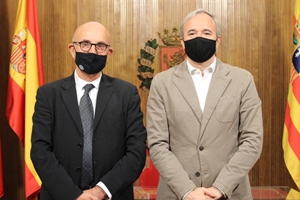
Meeting between Raúl Compés, director of CIHEAM Zaragoza, and Jorge Azcón

On 30th March, Raúl Compés, director of CIHEAM Zaragoza, met Jorge Azcón, mayor of Zaragoza, to explore collaboration opportunities between both institutions. CIHEAM, the only intergovernmental organization in Aragon, has dedicated over 50 years developing cooperation in food and agriculture across the Mediterranean and further afield, building human capital and generating knowledge. In forthcoming years CIHEAM Zaragoza will be participating in development projects.

Inception Meeting to present the Living Lab of Huesca in the H2020 Project SmartCulTour

On 4 March 2021 an online meeting was held to launch the Huesca Living Lab, one of the six Living Labs set up in Europe for the European project SmartCulTour financed by the European Commission in the framework of the H2020 Programme. The aim of the Living Labs is to encourage networking between stakeholders of the territory in the tourist sector to generate and identify good practices and innovative solutions for sustainable cultural tourism that can be exchanged with other European regions. To quote Raúl Compés, Director of CIHEAM Zaragoza: “This European project, in particular the Living Lab of Huesca, poses a good example of how to apply the 2030 Sustainable Development Goals to the land of Aragon”. Compés also pointed out that SmartCulTour will facilitate the exchange of innovative tourist strategies between different European countries and share examples of Huesca’s good practices in cultural tourism. The meeting was organized by CIHEAM Zaragoza, coordinator of the Living Lab, and was held online with 35 experts in sustainable cultural tourism and cultural and rural development. It presented the main objectives and the Living Lab concept, characterized by a participatory approach that enables stakeholders to play an active role in the development of their Living Labs.

Following the presentation, Fernando Blasco, manager of TuHuesca and direct collaborator with the SmartCulTour project, provided contextual information about the tourist sector in the province of Huesca, pointing out the challenges faced as a result of the current pandemic. The Living Lab of Utsjoki (Finland) also presented their work, giving an idea of the international component of SmartCulTour.


Each Living Lab is set up as a practical community made up of local experts and a wide range of sectors and stakeholders in the field of tourism. The Living Labs have been chosen based on criteria of geographical relevance and representativity of different models of sustainable tourism.  During the project, each Living Lab will implement, test and assess new forms of managing sustainable cultural tourism by identifying and replicating good practices in the sector, through serious games, arts-based methods, services and social design techniques to improve collaboration between the culture sector and the tourist industry to develop a capacity-building process. The other Living Labs are situated in Rotterdam (Holland), Scheldeland (Flanders, Belgium), Utsjoki (Lapland, Finland),  Split (Croatia) and Vicenza (Italy).

SmartCulTour began in January 2020 and will run until June 2023 with the following objectives:

  • to support regional development in all European regions with important tangible and intangible cultural assets, including those located in rural peripheries and the urban fringe, through sustainable cultural tourism.
  • to redefine cultural tourism from a contemporary perspective and provide a general framework to quantify supply, demand and impacts.
  • to contribute to the formulation of theories, empirical validation of good practice and the development of procedures, particularly to provide European regions with a series of strategies to ensure the commitment of stakeholders and work together to create experiences of sustainable cultural tourism.