Advanced course on statistical tools for plant phenomic data analysis

In January 2020, the Mediterranean Agronomic Institute of Zaragoza (IAMZ-CIHEAM), with the collaboration of the European Plant Phenotyping Network (EPPN2020), will host an advanced course on statistical tools for plant phenomic data analysis in Zaragoza (Spain).

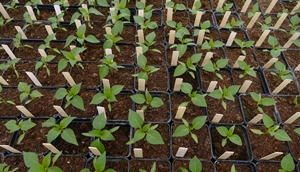
Effective field-based high-throughput phenotyping is key for future breeding advances, but it generates huge volumes of data points through time requiring special statistical methods to extract meaningful information for plant breeding purposes. This course intends to provide participants with information on the different platforms, sensors and carriers used for plant phenotyping as well as the suitable experimental designs and analysis using mixed models. Participants will be able to correct extracted plant features for spatial and temporal trends, learn about the potential of integrating secondary plant traits in genetic models for prediction of yield and will acquire practical experience in applying statistical methods through the analysis of case studies and hands-on exercises. For more information, visit the course website: Statistical tools for plant phenomic data analysis

Advanced International Course on Social Innovation in Rural Areas

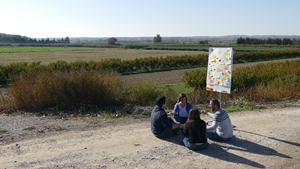
An advanced course on Social Innovation in Rural Areas will be held at the Mediterranean Agronomic Institute of Zaragoza (Spain) on 18-22 November 2019. This course is part of the EU-funded project Social Innovation in Marginalised Rural Areas (SIMRA) (www.simra-h2020.eu), which is built on making a better use of social innovations to assure the development of less-favoured rural areas.

Social innovation has been heralded as a vital part of the European recovery project since the economic crisis in 2008. It is of particular importance to rural areas, especially more disadvantaged rural areas, where multiple problems of depopulation, environmental quality decline and low levels of economic activity have been recurrent. With the trend of rapid urbanisation, the remoter rural areas will continue to be adversely affected.

In these areas, the state and municipalities often struggle to maintain basic public services because of public sector austerity. Markets are weak and there is still a high dependency on primary industries. This creates space and opportunities in which civil society can take on an increasingly important role in sustaining and improving conditions.

Throughout Europe and more widely, there are compelling examples of how civil society actors alone or with other partners have been able to take the lead in community economic development in the land-based sector and beyond, revitalising social capacities in fragile communities and supporting environmental improvements.

Behind the political rhetoric of leading global figures such as Manuel Barroso and Barack Obama, social innovation is a contested concept with multiple meanings and different interpretations. Greater clarity is urgently needed as to what social innovation is, how it can best be supported and where its efforts should be concentrated.

This course is part of the EU-funded Social Innovation in Marginalised Rural Areas (SIMRA) project (www.simra-h2020.eu). The project is built on more effectively linking the practice community with the research community to allow the integration and cross fertilisation of knowledge and understanding.

More information on the course: http://edu.iamz.ciheam.org/social_innovation/en/

New advanced course on diagnostics and prevention for fish parasite control in aquaculture

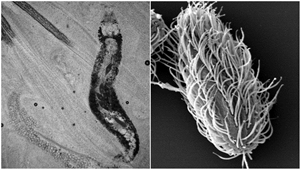
Early and correct diagnosis, efficient preventive and palliative measures, and accurate epidemiological studies are key to reduce the impact of pathogens in the aquaculture sector. Providing over 18 hours of in-class training and 14 hours of practical work, this course offers a complete overview of the main parasitic diseases in marine and freshwater aquaculture in the Mediterranean region, as well as diagnostic methodologies, disease assessment and prevention and control measures. Besides, it is a unique opportunity to meet and work with professionals from all over the world and share hands-on experience with top experts.

Marine and freshwater finfish aquaculture in the Mediterranean region is nowadays a fast expanding sector in animal production. Gilthead sea bream, European sea bass, rainbow trout, common carp and other species are the most farmed fish in Mediterranean countries and provide high quality animal protein from aquatic origin. These farming activities also contribute significantly to wealth and job creation in coastal and rural areas. However, diseases are still a limiting factor for the development of a sustainable production.

Amongst other diseases, parasites and related infections can cause significant damages to farmed fish species resulting in poor growth performance, impaired welfare and high mortality rates, with significant consequences in terms of production and economic performance. The high impact of these parasitic diseases and the low availability of control tools have called the attention of European authorities for further research that is addressed through several EU H2020 projects.

Early and accurate diagnosis, efficient preventive and palliative measures and precise epidemiological surveys should be the key to reduce the impact of these pathogens in this sector.

The general objective of the course is to provide integrated information on fish parasites affecting marine and freshwater fish farming in the Mediterranean region, focusing on the most recent knowledge of the main parasitic diseases, diagnostic methods, disease assessment and preventive and control measures.

For more information on the course: http://edu.iamz.ciheam.org/fish_parasite_control/en/

IAMZ-CIHEAM 50th Anniversary Event at Spain’s Ministry of Agriculture, Fisheries and Food

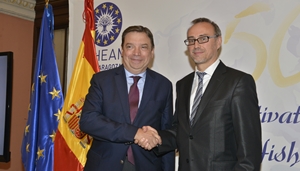
On 5 July, Spain’s Acting Minister of Agriculture, Fisheries and Food, Luis Planas, attended IAMZ-CIHEAM’s 50th Anniversary Event at the Ministry in Madrid. Mr Planas emphasized the “important role played by IAMZ in the area of education and research” and highlighted the number of professionals trained at IAMZ who are now in senior positions in many different countries. He also pointed out that IAMZ’s intense activity needs to be disseminated more widely, especially the training activities such as Master of Science programmes or advanced courses such as the one held recently on ‘Xylella fastidiosa’.

In his welcoming speech, IAMZ Director, Javier Sierra, recalled that over these 50 years of history, more than 15,000 leaders of the agrofood sector –mainly from Mediterranean and Latin American countries– have been trained at IAMZ, a centre of excellence offering continued and postgraduate training and coordinating international projects as well as a consolidated programme of transboundary research networks. “For Spain, this Institute has attained top level  international recognition, and is a key instrument for a country occupying one of the highest positions in the world ranking of exporters and in the production of wine, olive oil or fruit, besides being one of the world’s biggest consumers of seafood”.

CIHEAM Secretary General, Plácido Plaza,  reiterated his support of the idea of triangular cooperation with Africa, and referred to the Mediterranean as an “essential interface for EuroAfrican relations, where CIHEAM, with its decades of experience, is at the disposal of States and their partners to strengthen cooperation schemes with subSaharan countries”.

On the other hand, Mohammed Sadiki, President of CIHEAM Governing Board, stressed the role of this intergovernmental organization which “true to its training and research mission, works through its Institutes on issues which contribute to tackling structural problems in the Mediterranean region, especially climate change, migrations, youth employment or empowerment of women”.

The event was also attended by Juan Sainz Herrero, Assistant Director-General for Bilateral Economic Relations and Economic Diplomacy, Ministry of Foreign Affairs, European Union and Cooperation, and Cristina Miranda Gozálvez, Deputy Head of the Unit ‘Global issues and relations with African, Caribbean and Pacific countries’ at the Directorate General for Agriculture and Rural Development in the European Commission, who explained the agenda for the new Africa-Europe Alliance and its future challenges.

Likewise, former students Monia Ben Kaabia, PhD in Economics and lecturer at the School of Economics and Business of the University of Zaragoza, and Eduardo Berges, Regional Director for South Europe and North Africa at DSM Nutritional Products and CEO of DSM Iber, addressed all participants and explained the impact that their studies at IAMZ has had on their professional career.

CIHEAM has worked closely with the Food and Agriculture Organization of the United Nations (FAO) for more than 40 years and José Graziano da Silva, FAO’s Director General participated in the event with a message of greeting via video broadcast.

Photo gallery of the event: shorturl.at/vwJQX

FAO experts in the course “Seafood Value Chain Analysis”, organised by the Mediterranean Agronomic Institute of Zaragoza (IAMZ-CIHEAM)

This week, the course “Seafood Value Chain Analysis” will be covering new tools and trends in a key sector contributing to economic growth and the achievement of the UN Sustainable Development Goals. The course is part of the special activities organised on the occasion of CIHEAM’s 50th anniversary.

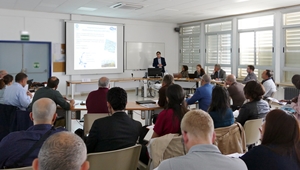
Experts from universities and specialized centres in Spain, France, Denmark, Italy and Norway are teaching in the one-week advanced course “Seafood Value Chain Analysis”, organised by the Mediterranean Agronomic Institute of Zaragoza (IAMZ-CIHEAM) and the Food and Agriculture Organization of the United Nations (FAO).

The one-week course, is part of the special activities organised on the occasion of the Institute’s 50th anniversary and aims to look into new tools and trends in the seafood value chain, one of the sectors expectedto develop significantly in the next few years in the Mediterranean scenario and to contribute to the economic growth and the achievement of the UN Sustainable Development Goals.

Value Chain Analysis (VCA) is a tool that helps to understand how the actors (companies, communities, workers and authorities) take part in the transformations of the regional and global economies and are affected by them. The course is focused on the structural changes that take place at an industrial level and on the leverage points, and concepts of governance, sustainability, value distribution and efficiency. Therefore it addresses issues such as trade relations, regulations, analysis and market trends, marketing and labeling, e-commerce, technological opportunities, circular economy or innovation.

More than 40 professionals from 21 countries are attending the course, most of them from Mediterranean countries, but also from northern Europe, Latin America and Oceania.

The course counts on FAO experts John Ryder (Head of the Products, Trade and Marketing Branch of the Fisheries and Aquaculture Department), Stefania Vannuccini (Head of Fishery and Aquaculture Statistics) and Stephanie Gallatova (Agro-Industry and Infrastructure Officer), and on the expertise of Gonzalo Campos (SEALED AIR PACKAGING Senior Fish Marketing Manager for Europe), José Manuel Fernández Polanco and Ignacio Llorente García (University of Cantabria in Spain), Diego González Lages (MAREL Sales Director Fish Industry), Patrice Guillotreau (University of Nantes), Lucas Herry (Fisheries and Aquaculture consultant at AND International in France), Bent Larsen (BELCO Ltd in Denmark) and Torbjørn Trondsen (UiT The Artic University of Norway).

CIHEAM President and Secretary General for Agriculture in Morocco visits IAMZ to celebrate its 50th anniversary

Mohammed Sadiki, President of the Governing Board of the International Centre for Advanced Mediterranean Agronomic Studies (CIHEAM) and Secretary General for Agriculture and Fisheries of the Government of Morocco, and Plácido Plaza, Secretary General of CIHEAM, have listened to IAMZ’s work plan and objectives for the forthcoming years.

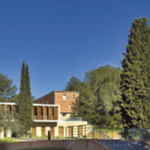
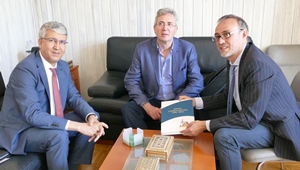
Mohammed Sadiki, President of the Governing Board of the International Centre for Advanced Mediterranean Agronomic Studies (CIHEAM) and Secretary General for Agriculture and Fisheries of the Government of Morocco, together with CIHEAM Secretary General Plácido Plaza, have visited the Mediterranean Agronomic Institute of Zaragoza on the Campus of Aula Dei in Montañana on Tuesday as part of the special programme of events organised by the Institute to celebrate their 50th anniversary in 2019. Mohammed Sadiki and Plácido Plaza have met with the Director of IAMZ, Javier Sierra, who has presented a balance of the Institute’s activities and explained the strategic objectives set by the centre for the forthcoming years.

IAMZ, a centre of excellence and international point of reference in advanced training and cooperation is one of the four institutes, together with Bari (Italy), Montpellier (France) and Chania (Greece) that comprise the International Centre for Advanced Mediterranean Agronomic Studies (CIHEAM), whose headquarters are in Paris. Over 15 000 young leaders of the agrifood sector in the Mediterranean and Latin America, among other countries, have received training at IAMZ over the past five decades.

IAMZ was founded in 1969 on the Campus of Aula Dei in Montañana by the Aragonese agronomist Ramón Esteruelas and has become a consolidated centre of reference in training and agriculture and international cooperation. IAMZ has delivered more than 400 advanced courses, inviting over 1000 lecturers and experts in each topic from universities and centres of reference worldwide, and has awarded 6700 scholarships.

Agreement with the National Institute of Field Crops of Tunisia

Besides training, the Mediterranean Agronomic Institute of Zaragoza promotes cooperative research networks and participates in cooperation projects. IAMZ has participated in over 40 research projects and networks and signed agreements with more than 60 national and international organisations. The most recent agreement was signed last week in Tunis with the National Institute of Field Crops of Tunisia, of the Tunisian Ministry of Agriculture, to promote joint actions in the areas of plant breeding, protected crops, water governance and irrigation.

About CIHEAM The Mediterranean Agronomic Institute of Zaragoza (IAMZ) is one of the four institutes that execute CIHEAM’s activities. The International Centre for Advanced Mediterranean Agronomic Studies is an intergovernmental organisation created in May 1962 upon the initiative of the OECD and the Council of Europe, in order to promote cooperation between Mediterranean countries through post graduate training and cooperative research in the areas of agriculture, food and sustainable rural development. It has 13 member countries and headquarters in Paris. FAO (Food and Agriculture Organization of the United Nations), the OECD, the European Food Safety Authority (EFSA) or the European Commission are among the international bodies with which CIHEAM collaborates to carry out their current projects.